sx blog
Our digital space for brief commentary and reflection on cultural, political, and intellectual events. We feature supplementary materials that enhance the content of our multiple platforms.
Rosamond S. King to celebrate new collection with book launch party
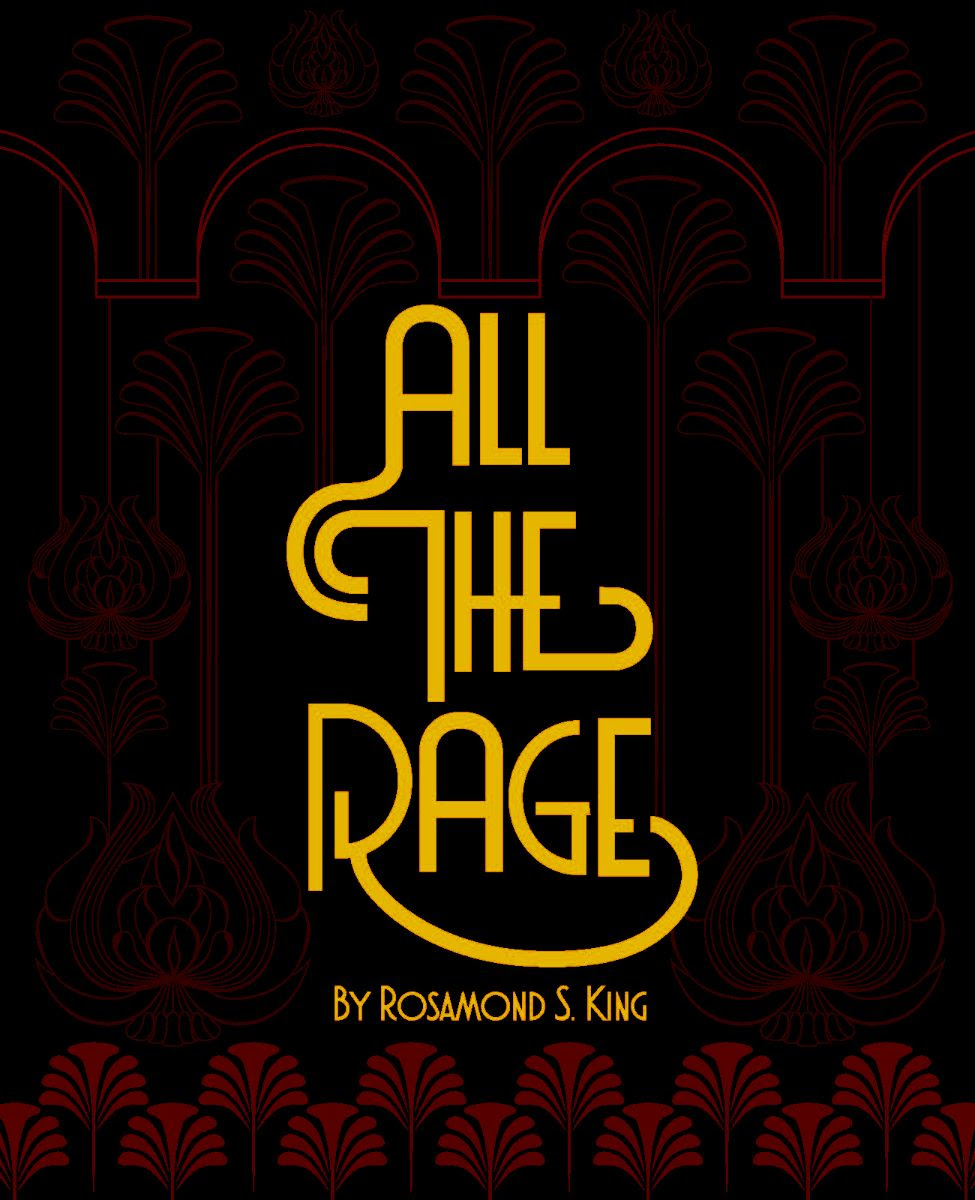
Date: Friday, April 9th
Time: 6:30 pm EST
Poet and sx salon creative editor Rosamond S. King will celebrate the launch of her new book, All the Rage, at a special edition of Gibney’s Living Gallery. RSVP here.
All the Rage addresses everyday pleasure as well as the present condition of racism in the United States—a time marked both by recurring police violence and intense artistic creativity—from a variety of perspectives: being Black, an immigrant, a woman, and queer. At its core dwells “Living in the Abattoir,” a series in which people of color live out their days as both workers and meat. All the Rage simultaneously invokes both anger at ongoing systemic violence and the frivolity of something that is, perhaps temporarily, “trending.” Read more & buy All the Rage here.
Off the Page: Julia Alvarez & Vanessa Pérez-Rosario in conversation
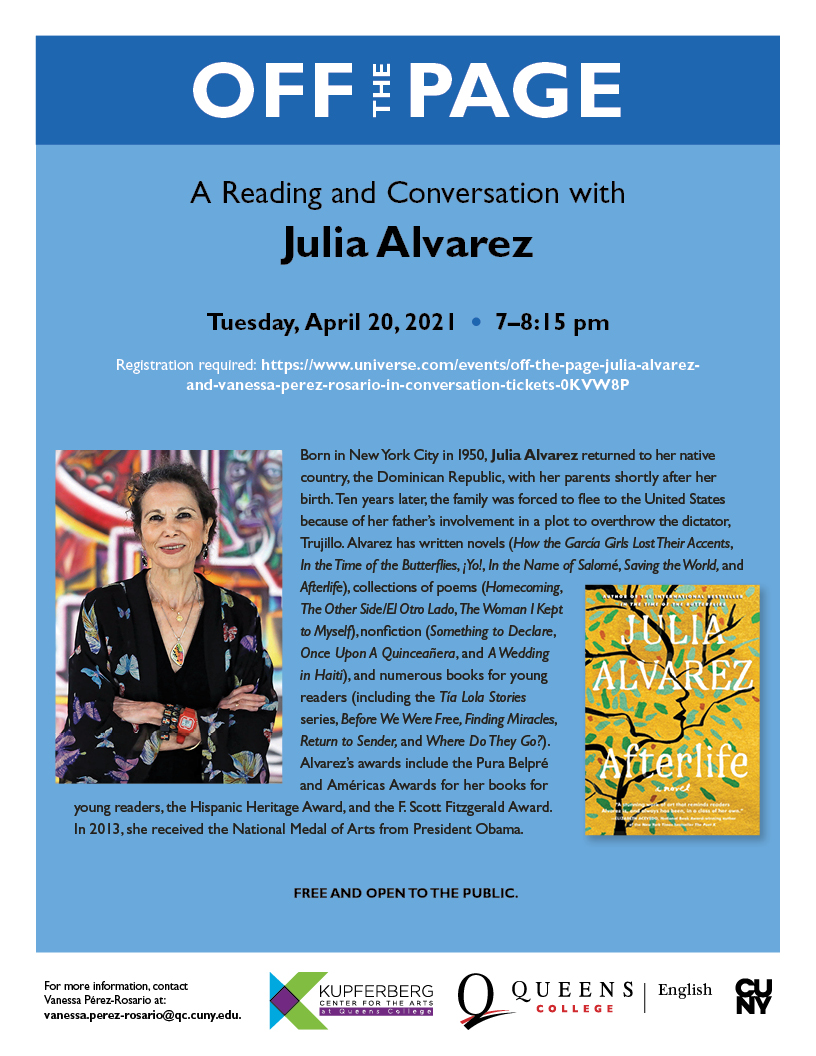
Date: Tuesday, April 20th
Time: 7pm EST
From the Kupferberg Center for the Arts website:
OFF THE PAGE: Conversations with Writers is a Queens College series produced by Kupferberg Center for the Arts, the Department of English, the Provost’s Office, and the Dean of the School of Arts and Humanities. Curated by QC professor, author and Small Axe managing editor Vanessa Pérez-Rosario.
This event with Julia Alvarez is funded in part by Poets & Writers through public funds from the New York City Department of Cultural Affairs, in partnership with the City Council.
Read more about the event and register here.
About Julia Alvarez
Born in New York City in 1950, Julia Alvarez’s parents returned to their native country, Dominican Republic, shortly after her birth. Ten years later, the family was forced to flee to the United States because of her father’s involvement in a plot to overthrow the dictator, Trujillo.
Alvarez has written novels (How the García Girls Lost Their Accents, In the Time of the Butterflies, ¡Yo!, In the Name of Salomé, Saving the World, Afterlife), collections of poems (Homecoming, The Other Side/ El Otro Lado, The Woman I Kept to Myself), nonfiction (Something to Declare, Once Upon A Quinceañera, and A Wedding in Haiti), and numerous books for young readers (including the Tía Lola Stories series, Before We Were Free, finding miracles, Return to Sender and Where Do They Go?).
Alvarez’s awards include the Pura Belpré and Américas Awards for her books for young readers, the Hispanic Heritage Award, and the F. Scott Fitzgerald Award. In 2013, she received the National Medal of Arts from President Obama.
CuCa3: Cuir Caribbean Voices/Voces Queer del Caribe
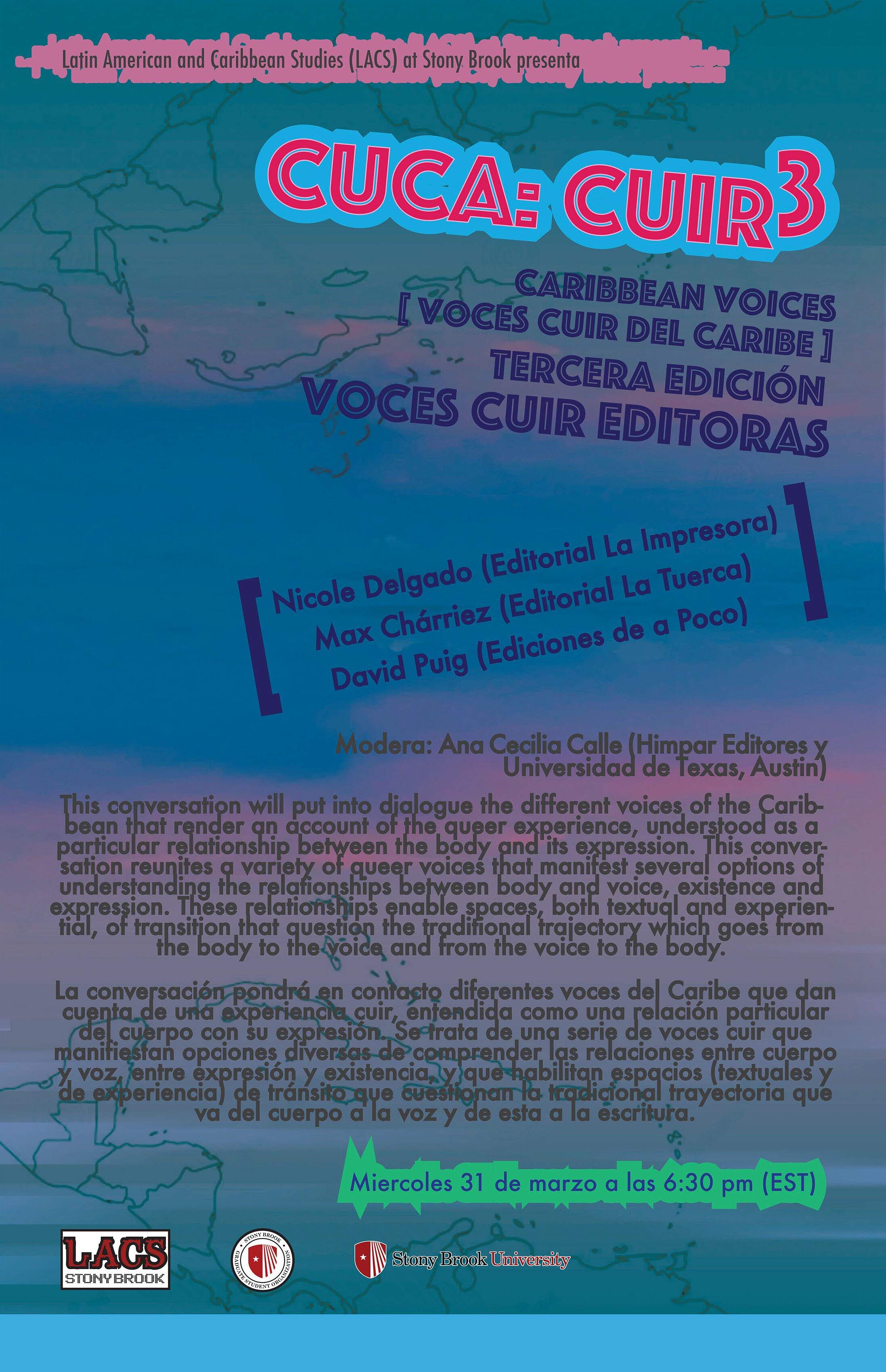
Date: Wednesday, March 31st
Time: 6:30 pm EST
From LACS Stony Brook:
CuCa Cuir is back! Join us for the third installment of this LACS' graduate student-initiated series. This session focuses on independent queer presses.
CuCa3: Cuir Caribbean Voices/ Voces Queer del Caribe
Voces Cuir Editoras
Organized by PhD candidate Mario Henao (Hispanic Languages and Literature)
Life Portrait & Libations: a Celebration of Colin Robinson
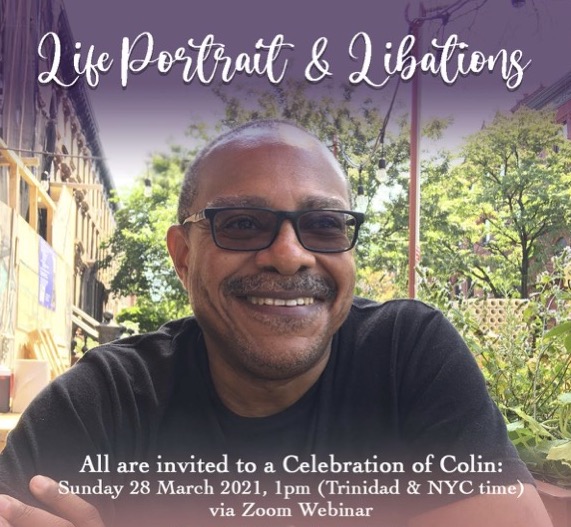
In remembrance of Trinidadian poet and LGBTQ+ advocate Colin Robinson, there will be an online memorial service that is open to all on Sunday 28th March. Please find the details of the event below. Read some of Robinson's poems that were published in sx salon here.
Life Portrait & Libations
All are invited to a Celebration of Colin:
Sunday 28 March 2021, 1pm Trinidad & NYC time
via Zoom Webinar:
https://us02web.zoom.us/j/81928208620?pwd=cWhGck1TVmo4Y3lOcmNLOEtFc29DZz09
Passcode: 423395
Instead of flowers, please contribute funds to the Colin Robinson Hard Head Award. To donate, please email caisott@gmali.com. For more information about the award, visit: https://caisott.org/hard-head-award.
Because so many people loved and worked with Colin, we've created a way everyone can share their remembrances. To upload a short video about Colin, visit: https://share.vidday.com/o-hlgsgk.
The invite PDF attached here includes the clickable zoom link, but you may find it difficult to upload to social media. To invite folks through social media, please share posts by CAISO - @CAISOTT on Twitter and Instagram; CAISO Sex & Gender Justice on FB.
Ian Randle Press publishes Methodologies in Caribbean Research on Gender and Sexuality
Ian Randle Press publishes Methodologies in Caribbean Research on Gender and Sexuality
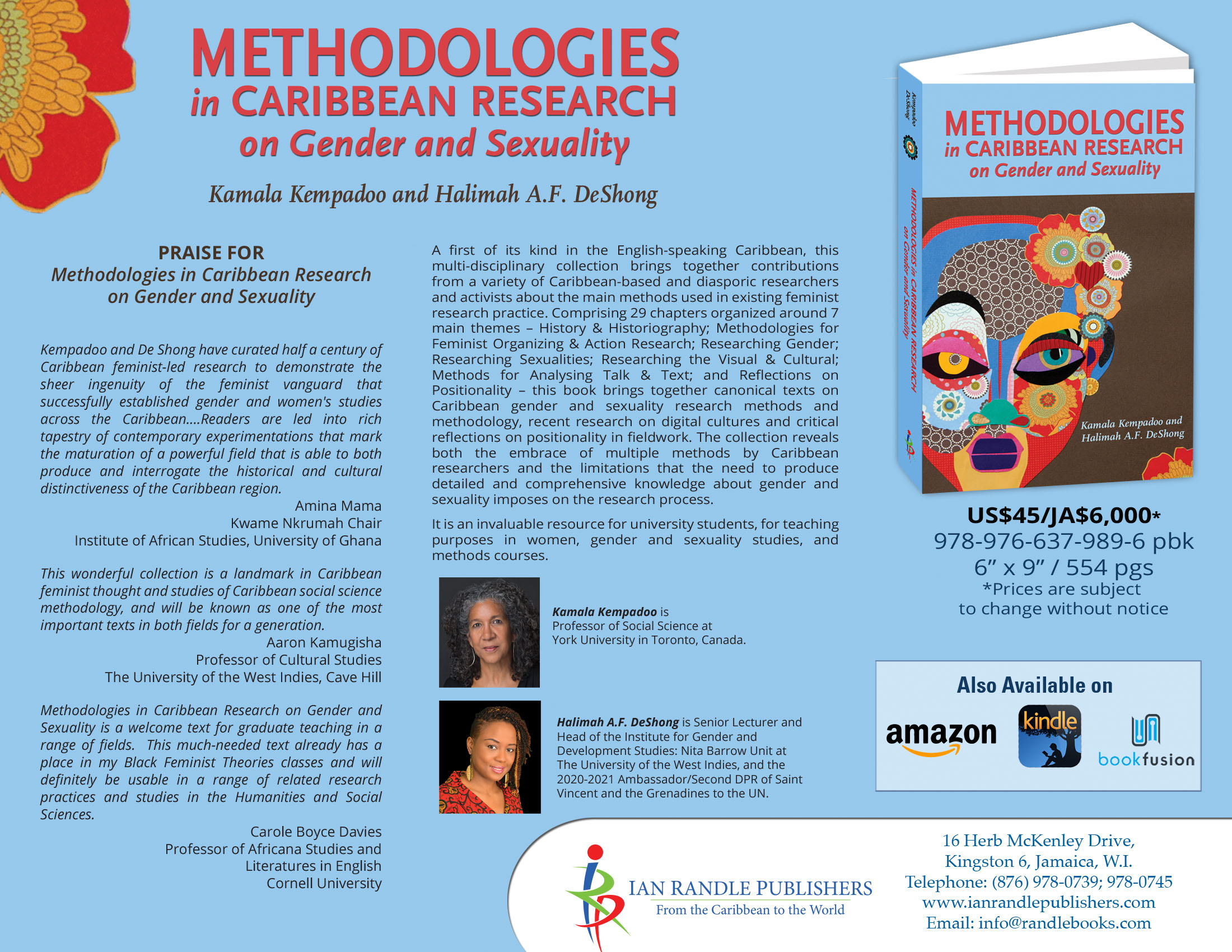
A first of its kind in the English-speaking Caribbean, Methodologies in Caribbean Research on Gender and Sexuality brings together contributions from a variety of Caribbean-based and diasporic researchers and activists about the main methods used in existing feminist research practice. Edited by professors Kamala Kempadoo and Halimah A. F. DeShong and comprising 29 chapters organized around 7 main themes – History & Historiography; Methodologies for Feminist Organizing & Action Research; Researching Gender; Researching Sexualities; Researching the Visual & Cultural; Methods for Analysing Talk & Text; and Reflections on Positionality – this book brings together canonical texts on Caribbean gender and sexuality research methods and methodology, recent research on digital cultures and critical reflections on positionality in fieldwork. The multi-disciplinary collection reveals both the embrace of multiple methods by Caribbean researchers and the limitations that the need to produce detailed and comprehensive knowledge about gender and sexuality imposes on the research process.
It is an invaluable resource for university students, for teaching purposes in women, gender and sexuality studies, and methods courses.
Zora's Daughters co-hosts to facilitate "Honoring the Ancestors: Black Feminist Citational Praxis, an interactive workshop"
Zora's Daughters co-hosts to facilitate "Honoring the Ancestors: Black Feminist Citational Praxis, an interactive workshop"
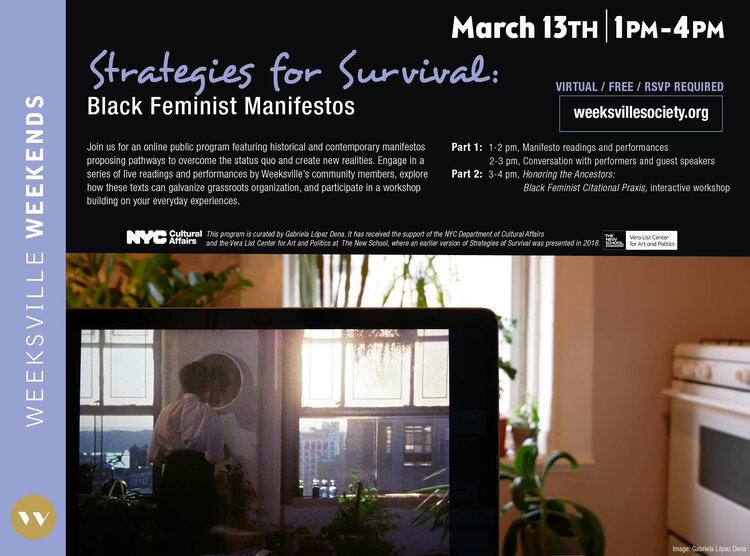
Date: Saturday, March 13th
Time: 3-4pm EST
sx editorial assistant Alyssa James will co-facilitate "Honoring the Ancestors: Black Feminist Citational Praxis, an interactive workshop" alongside her Zora's Daughters podcast co-host Brendane Tynes as part of Strategies for Survival: Black Feminist Manifestos. This series by Weeksville Heritage Center is an online public program engaging with a series of historical and contemporary manifestos resonant with the explosive reality we experience now. Zakiya Collier, a Project Archivist for the Weeksville Heritage Center, will also co-facilitate the event.
Written by Black feminist artists, activists, and writers and performed by Weeksville community members, these texts point to circumstances that are unacceptable and in need of change. But most importantly, they propose pathways to move forward in order to overcome the status quo and create new realities. In the midst of political uncertainty and a physically isolating pandemic, these statements offer visions that can help us connect with one another and transcend what feels like a never-ending crisis.
"Wayward Archives and Decolonial Interventions: Examining Intimate Histories with the Virgin Islands Studies Collective."
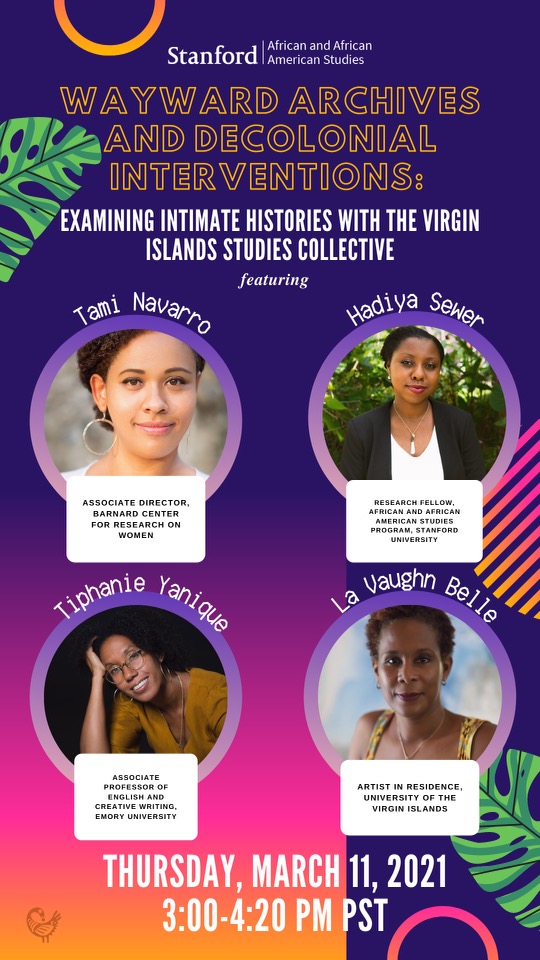
An anthropologist, an artist, a writer, and a philosopher collaboratively engaged the prison records of four Afro Caribbean women who led a 19th century labor riot in St. Croix, Danish West Indies (now U.S. Virgin Islands). Join the VI Studies Collective for a panel about intimate histories, collaborative research, and Black feminist decolonial archival interventions.
The VI Studies Collective consists of:
Tami Navarro, Associate Director, Barnard Center for Research on Women; Small Axe editorial committee member
La Vaughn Belle, Artist in Residence, University of the Virgin Islands
Hadiya Sewer, Research Fellow, African and African American Studies Program, Stanford University
Tiphanie Yanique, Associate Professor of English and Creative Writing, Emory University
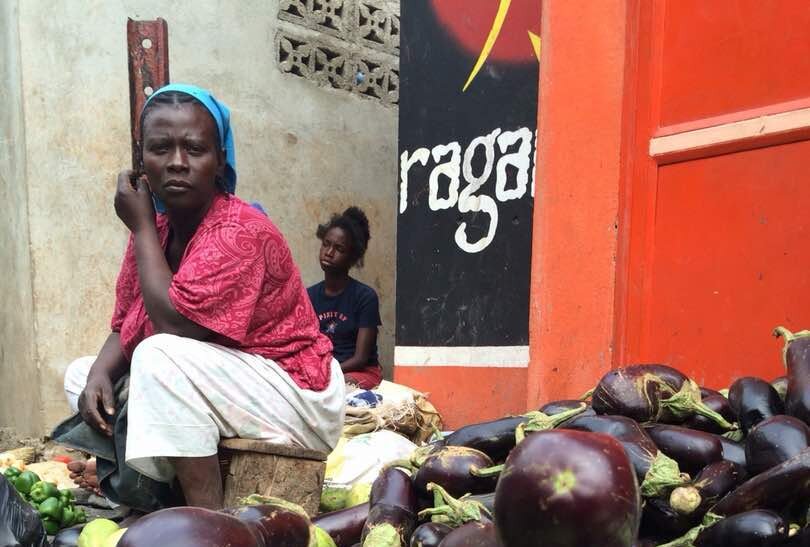
Intl. Women's Day Screening of Madan Sara & Review by Régine Jean-Charles
Intl. Women's Day Screening of Madan Sara & Review by Régine Jean-Charles
Date: Monday, March 8th
Time: 6pm EST
From the screening's Eventbrite:
On International Women's Day 2021, the Center for Experimental Ethnography is pleased to present Haitian filmmaker Etant Dupain's feature "Madan Sara: Pouvwa Fanm Aysiyen" (Madan Sara: The Power of Haitian Women) followed by a discussion between Etant Dupain (Director, Madan Sara), Dr. Régine Michelle Jean-Charles (Associate Professor of French and the Graduate Program Director at Boston College), and Lunise Cerin (Editor, Madan Sara). The CEE screening of Madan Sara follows a four-day series of free, public screenings of the film throughout Haiti, supported by matenmidiswa pwodiksyon.
Spaces are limited, so reserve your spot today by following this link to register for the event.
For more information on future film screenings and to support the efforts of the Madan Sara Project as they work to share the film across Haiti, please visit MadanSaraFilm.com.
Small Axe editorial committee member Régine Jean-Charles also wrote "'Madan Sara' Tells the Story of Haitian Women Both Ordinary and Extraordinary," a review of the film, for Ms. magazine. Read it here.
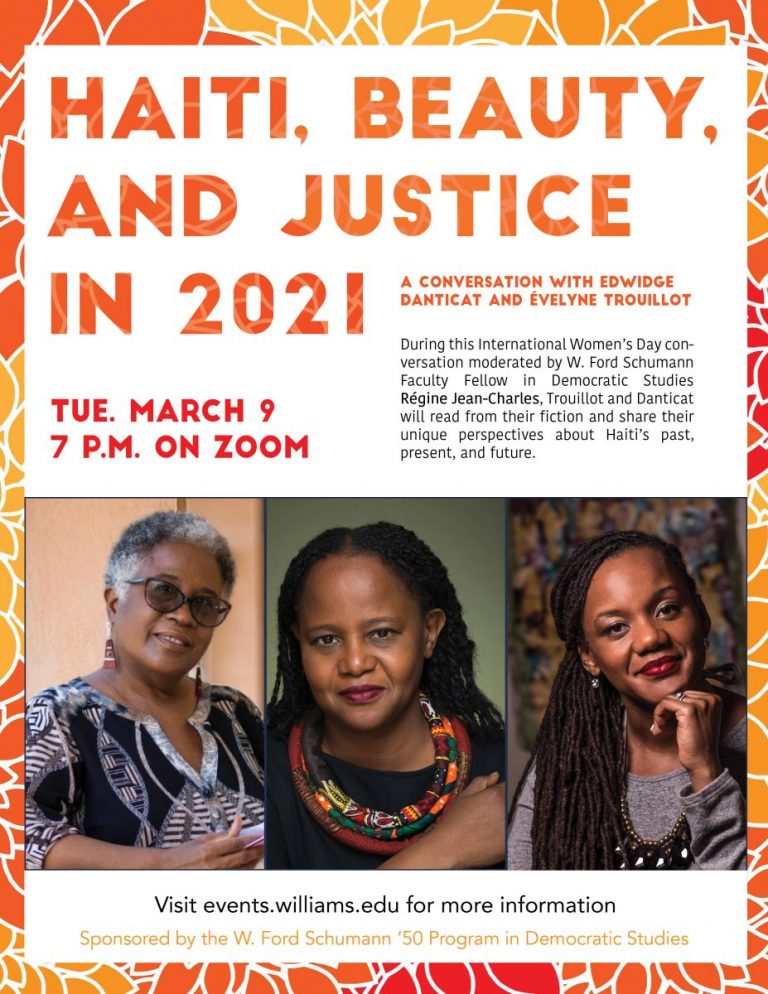
Régine Jean-Charles to moderate "Haiti, Beauty, and Justice in 2021: A Conversation with Edwidge Danticat and Évelyne Trouillot"
Date: Tuesday, March 9th
Time: 7pm EST
From the event website:
During this International Women’s Day conversation moderated by W. Ford Schumann Faculty Fellow in Democratic Studies Régine Jean-Charles, Évelyne Trouillot and Edwidge Danticat will read from their fiction and share their unique perspectives about Haiti’s past, present, and future.
In a recent essay, the award-winning Haitian author Trouillot writes, “…my writings, stemming from my lived experience and my aesthetic and social vision for a more beautiful and just world, are presented to readers who are not always acquainted with my reality…” The same can be said of the internationally acclaimed author Danticat whose writing set in Haiti and in the Haitian diaspora reflects a commitment to humanity, beauty, and justice.
"American Violence and the Haunting Diagnosis of Richard Hofstadter," an essay by Harvey Neptune
Historian Richard Hofstadter haunts US history. And for good reason. An academic and public intellectual who passed away over half a century ago, Hofstadter authored works, in a relatively short but astonishingly prolific lifetime, that diagnosed the nation with ailments that seem chronic today. In books like The American Political Tradition (1948), The Age of Reform (1955) The Paranoid Style of American Politics (1965), Anti-intellectualism in American Life (1963) and American Violence (1970), he depicted capitalism, racism, cultivated ignorance and violence as endemic to hegemonic US political culture.
Yet even as the national intelligentsia increasingly has acknowledged Hofstadter’s profound relevance, especially since the emergence of Trumpism, they have not quite appreciated the radical depths and subtlety of his sophisticated skeptical mind. Above all, they have repressed that at the core of his scholarship was a post-nationalist warning, an historically informed counsel that the premise and promise of American greatness imperiled the Republic and the world. Commentators, it seems, have been wilfully blind to the urgency of Hofstadter’s criticism. It is almost as if they have been afraid to admit what he actually said about the US.
Hofstadter’s corpus is too rich for easy summary, but it is not difficult to realize that he wrote to upset a certain complacency about the dominant nationalist tradition. Drawn to the dark side of American life, he refused to indulge the patriotic liberal romance of ineluctable progressive change. Rather, Hofstadter made it his intellectual duty to disenchant, to illuminate the national experience from what he called the “nether end.” Regarding his native civilization in the middle of the century, Hofstadter offered these words: “I do not like to be unduly pessimistic, but it seems to me that in the race between education and catastrophe, catastrophe thus far is ahead by several lengths.”
Notoriously schooled as a nationalistic cheerleader, Hofstadter was anything but. His first public facing book, The American Political Tradition explicitly warned against “hero-worship and national self-congratulation.” This 1948 work also came out swinging against capitalist greed. US democracy, observed the introduction, was a “democracy in cupidity rather than a democracy of fraternity.” During the next decade, Hofstadter persisted with his critically diagnostic ways, emphasizing what he dubbed the “paranoid style of politics” in the US. Detractors today often dismiss his line of argument by mistakenly assuming that he saw the irrationality as an attribute exclusively of the radical right. To the contrary, however, Hofstadter plainly stated that although his book focused on “pseudo-conservatives,” the paranoid mentality that believed itself to be “in the grip of a vast conspiracy’ was “not a style of mind confined to the right wing.”
One of the most underappreciated aspects of Hofstadter’s writing about the nation’s dysfunctional cultural politics was the centrality of white supremacy (anti-Semitism, it is often forgotten, was at the center of the controversy set off by The Age of Reform). “Ethnic animosities,” he explained in The Paranoid Style, “at times almost a substitute for the class struggle and in any case have always affected its character.” Moreover, Hofstadter, whose father was Jewish, had betrayed a concern with racism from incipience; his very first book, Social Darwinism in American Thought (1944), climaxed with a chapter on “racism and imperialism.” In that same year, Hofstadter jointed others at the Journal of Negro History in the attack on the racist scholarship of Ulrich B Philips. In this move, he was likely influenced by the work of his then wife Felice Swados, who also published historical scholarship about plantation slavery. A few years later, Hofstadter would take a sardonic swipe at Jefferson’s slave-owning privilege, noting in the American Political Tradition that the “leisure that made possible his great writings on human liberty was supported by the labors of three generations of slaves.”
Furthermore, while it would be too much to present Hofstadter as some kind of apostle of intersectionality, his work consistently connected anti-Semitism and Negrophobia to other social power struggles and prejudices. Anti-intellectualism was part of a primitivism inseparable from militant sexism, he insisted. Far more sensitive to issues of gender than might be expected of a stereotypical male historian in the middle of the century, Hofstadter not only published work concerned with representations of masculinity and femininity but also did so in an American Quarterly article co-authored with his second wife, Beatrice Hofstadter (fascinating footnote: his first wife, Felice, penned the classic prison novel, House of Fury, a work that entangled race, class, gender and sexuality with such an authentically militant spirit of protest that the author was mistaken for a “Negro.”)
Finally, while professional folklore has linked Hofstadter to “American exceptionalism,” his approach to the US in a global context was almost unthinkable for its radically humbling implications. After all, which native political observer can we imagine at the height of the Cold War conceiving of a scenario in which the war turned hot, the superpowers wound up inferior to Africa and Asia and Latin America and the resultant new “diffusion of power through the globe” produced a “healthier situation”? Yet this is exactly what Hofstadter wrote in American Perspectives in 1950. This subversive anti-imperial vision never disappeared. One of Hofstadter’s last public comments offered the national diagnosis that “part of our trouble is that our sense of ourselves hasn’t diminished as much as it ought.”
In the end, if Hofstadter saw anything exceptional about the United States it was the society’s self-deceptive attitude toward its wasteful unjustifiable and largely conservative violence -- a violence that, in his view, left the Republic resembling countries in AFrica Asia and Latin Americas (countries now infamous for their “shitholery”). One of Hofstadter’s final publications, “Reflections on Violence in the United States,“ put the matter this way: “What is most exceptional about the Americans is not the voluminous record of their violence but their extraordinary ability in the face of that record to persuade themselves that they are among the best behaved and best regulated of peoples.”
Those of us concerned with comprehending the US past and the possibilities for present rehabilitation ignore the work of Richard Hofstadter at our peril. Until we wrestle with his sobering historical diagnosis of the Republic as one that “seems to slouch onward into its uncertain future like some huge inarticulate beast, too much attainted by wounds and ailments to be robust, but too strong and resourceful to succumb,” Hofstadter will continue to haunt us.
Author Bio
Harvey R. Neptune is an Associate Professor of History at Temple University. Neptune is the author of several published articles (appearing in journals including The American Historical Review, Small Axe and Radical History Review) and a book, Caliban and the Yankees: Trinidad and the US Occupation (UNC Press, 2007). Interested generally in the cultural politics of imperial and nation-building, Neptune is currently working on a book titled The Big Lie in US History: the making of the “Consensus school," which reconsiders the politics of US historiography in the postwar decades.