Deliberations on J’ouvert’s Retention/Reinvention
Deliberations on J’ouvert’s Retention/Reinvention

Quashie: deriving from the nineteenth-century colonial stereotype of the Quashee figure—pictorially enshrined by the British caricaturist George Cruikshank (1792–1878) in his 1842 Omnibus chapter “A Negro Boy in the West Indies.” Cruikshank, an antiabolitionist, depicts the Quashee archetype as slothful and submissive, one who not only welcomes but can benefit from colonial edification. The archetype undergoes metamorphosis, undermining its legacy through intervention from acclaimed twentieth-century Afro-Caribbean poets/scholars. The Jamaican poet Claude McKay (1889–1948), in his 1912 poem “Quashie to Buccra,” would depict the tribulations of the workers in juxtaposition to their subjugators’ pleasure.1 The term Buccra—etymologically deriving from the Efik/Ibibio seventeenth-to-nineteenth-century word mbakara, meaning “master”—became linked with the concept of Mbaka nkara, “divide and rule,” and was adopted by the African diaspora as a derogatory title for plantation overseers.2 The Barbadian scholar and poet Kamau Brathwaite (1930–2020), in his 1975 seminal text Caribbean Man in Time and Space would explore the Quashie figure in an effort to engender an understanding of the internalized complex of cultural dissonance experienced by the postemancipated African diaspora. Brathwaite registers the Quashie complex not as an impediment ascribed to the Afro-Caribbean figure but as a phenomenon of conditioning—an internalization through circumstantial subjugation and the manufacturing of superordinate discrimination that generated from cultural pluralism, créolization.
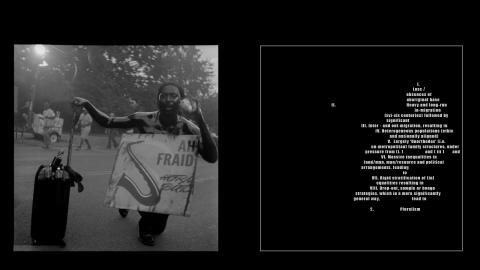
The complex metastasizes as a reaction to cultural destitution through loss of the aboriginal base resulting in individual disnomia: dependence, imitation, and the lack of initiative. Brathwaite expounds that the complex promotes an inhibition of growth, which discourages a realization of identity.3
The realization of identity . . .
“But what about the suitcases, what’s up with the suitcases?”
“Well, they say that most bury their dead, but we Grenadians carry them with us. The suitcases are the coffins . . . ,” my mother replies.
Within the Afro-Caribbean tradition, specifically among the Antillean island nations that were dominated by French colonial exploitation, the Afro-Créole practice of J’ouvert emerged as resistance through satirical masquerade. Jou ouvé or J’ouvert—a créolization of the French term jour ouvert, translated as “daybreak”—is the night procession that precedes the glamor of carnival day, occurring in the hours before dawn. J’ouvert exercised among those of Grenadian heritage specifically gives rise to the Jab Jab character. Several origin stories of the Jab personage have circulated, but according to the Grenada Cultural Foundation, the Jab was a slave, a Quashie figure, who met his death when he accidentally fell—or perhaps was pushed by a Buccra—into a copper vat of boiling molasses, his ghost returning every carnival season to torment the descendants of the colonizer.4
What is agreed upon is that the etymological derivative of Jab comes from the colonial French word diable: devil. The Grenada National Trust has detailed that prior to Grenada’s legal emancipation on 1 August 1834—inaugurated by the British Slavery Abolition Act (1833)—Afro-Caribbeans were derogatorily called “devils.”5 Anything involving African culture was subjected to vicious antagonisms and failed suppression. The European carnivals in the colonies preceding the Christian Lent season prohibited participation, in response, the enslaved as an act of satirical rebellion, transformed into the Jab. By varnishing themselves with any substance that would blacken their skin—molasses, tar, mud, engine oil, or liquified charcoal—the Jabs held their own procession insubordinately mocking the Buccra and reclaiming the very derogatory classification of “diable.” The impetus being, “You’re going to call us Devils? Well, we will show you true Devils.” As Jab, we blacken our skin to disavow the identity projected upon us by the colonial project. As Jab we wish to be darker, blacker diables, embracing blackened anonymity as resistance.
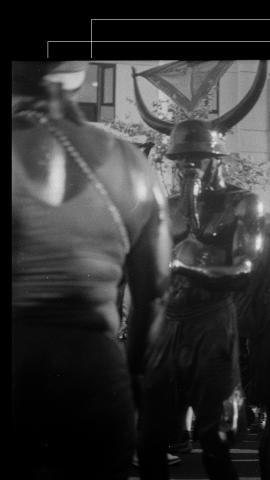
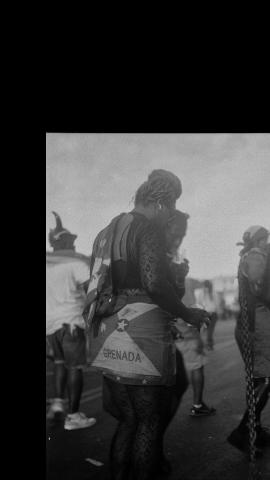
The procession became more prevalent with unconditional emancipation after the 1834–38 period. Everything the Buccra said was an abomination; our ancestors amplified it and took it to the streets in resilience. Along with the blackening of skin, accessories would consist of suitcases blackened and dragged as coffins to signify our dead, repurposed helmets fastened with cow or goat horns, and, in clenched hands, chains: emancipation from both physical and mental bondage. This is Brathwaite’s transfiguration of the Quashie complex in praxis; adorning the “double consciousness” as armor instead of shackle, procession as rehabilitation of the inner plantation.
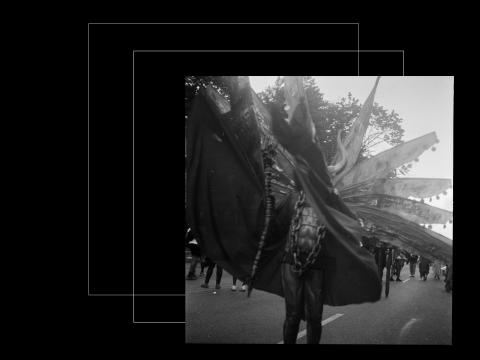
The Repiblik d’Ayiti (Republic of Haiti ) shares this specific heritage practice in resistance to the same colonial prohibitions, and Haitians have a near identical variation of the Jab Jab in the Lansèt Kòd (Lanceurs de Cordes). Prominent in the county of Jakmèl, the Lansèt Kòd adorn themselves with a mixture of charcoal powder and cane syrup—their tools are horns and whips. Reflective of their Jab Jab siblings, the Lansèt Kòd leave their imprinted mark by way of a blackened hand on spectators, evoking the Haitian proverb “Pito nou lèd, nou la,” which translates to “We may be ugly, but we are still here.”
Much like the impetus of Western modernity to diminutively utilize the stereotype of “Voodoo” superimposed on our people’s ancestral practice to sensationalize, entertain, and caricature—we of the Vodún tradition resist by way of transgression to neocolonial antagonisms. In our contemporary enclaves of diasporic movement, dissent takes formation, and subversion easily becomes circumstantial. At New York City’s annual West Indian Day Parade, established in 1947, neocolonial condescension persists—no cultural event is more heavily policed, surveilled, and exploited. Mayor Bill de Blasio in 2018 pushed our J’ouvert to 6 a.m.; the forwarded time is an antagonism, an attempted dissolution of our heritage practice. Regardless, we defy and gather just before 1 a.m. The metaphoric specificity of our procession is to march out of the night and into the dawn: this nautical twilight—before civil twilight—is our realization of identity. In 2022 Mayor Eric Adams enforced an additional twenty-five hundred police officers and the placement of metal detectors, NYPD helicopters, and multiple checkpoints.
By time you hit The Parkway at 1 a.m., Black bodies have already adorned themselves with Vaseline, liquid charcoal, and—for the purists—iconic motor oil.6 Those are your kinfolk among the fragmented pluralist cluster. Past the white lace dresses that ornament the Brown bodies of Dominica is your clan of Jabs ardently trying to make their Black skin blacker with pride. The message is evident: Embrace your darkest self and your compensation will be catharsis, the prayer that this procession simulates our ancestors’ movements toward emancipation. As Grenadians, this kind of method of self-reflection as catharsis is one of our contributions to the Antillean archipelago constellation.
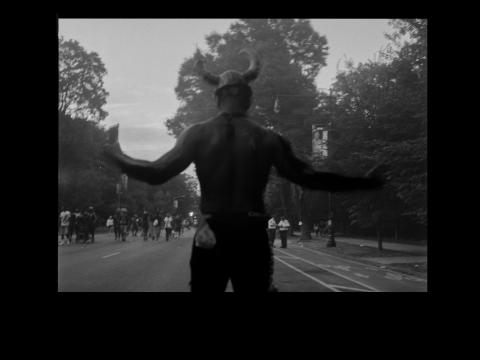
As Jab Jabs, we don’t laugh, we don’t smile. We’re having fun, but this is serious business.
—Kered Clement, a British born journalist currently residing in Grenada7
And as for your stride, it starts to adopt rhythm; from stationed trucks, the steel-pan bands are sonically commanding your muscles to release the year’s tension. However, intertwined in the melody is a familiar buzz: An NYPD drone—Buccra overseer—is hovering over the head of one of the steel-pan players. He is unaware or indifferent; he’s submerged within the communion around The Parkway—it engulfs you also with immediacy. It’s as if this stretch of Eastern Parkway, Empire Boulevard, and Flatbush Avenue have become a concrete simulation of the Caribbean Sea, and despite the invasive gentrification, we command these Brooklyn late-to-early hours as a chancel predella for spiritual reenactment.
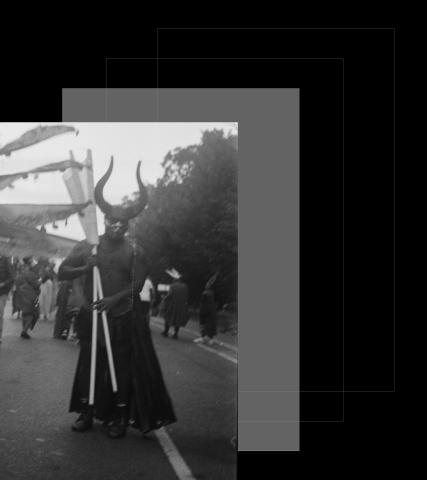
With your shirt still unsoiled, a jubilant Jab who’s spotted your Spice Island flag necktie, comes running toward you with a Bluetooth stereo blasting Jab soca music. He immediately positions himself to spoon your backside. You welcome this Jab wining your waist down as instruction, devoid of inhibition.
You’re being anointed into J’ouvert, the black grease secreting off his body baptizing you. The Jab, when satisfied that you’ve arrived to his level of energy, blissfully leaves you with badges of charcoal and black oil that will uniform you to your kin. Now you’re ready for the spiritualized bacchanal; leaving behind the threshold of sobriety, you enter J’ouvert blacker than when you first started. Another Jab comes toward you on The Parkway, staggering as if he’s been mounted by Papa Legba or Mèt Kafou incarnate and dragging a “coffin” behind him. His stagger stops right at your feet. He then genuflects and blows into a large conch shell: the call that it’s time to take formation onto the streets. Within the transcendence, it’s easy to forget you’re even still in an urban municipality, for a spatiotemporal distortion is active.
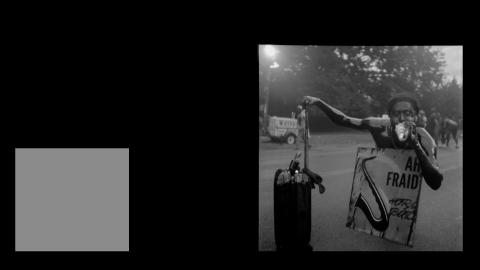
Transcendence can invoke the ontological spectrum between the embodiment of the emancipated or the Maroon tradition, the escaped who ventured away from plantations into the forest frontiers. Brathwaite cites the postulations of the Trinidadian professor-economist Lloyd Best—that Afro-Caribbean ontology is predominantly perceived historically through the exploited hinterland of the plantation’s relationship to the industrial metropole.8 That is reflected beyond the margins, where fugitive Maroon economies propagated in the form of communal agricultural barter—generative alternative economies that humanized: Susu hands and Gayap/Kayapa. These cooperative systems that are now heritage practices still inform the intimate foundations of our diaspora.
Brathwaite muses on the mentality of persistent poverty denoted in the Quashie complex; this phenomenon can give rise to false emancipations in the form of imitation. Not to succumb, that we are more than our chains, beyond—resistant to the abstraction of producers for the metropole, that autonomous dissent existed as kernel, an unwillingness to defer to circumstantial subjugation. The Jamaican cultural critic Sylvia Wynter weighs in on this dialectic in her unpublished “Black Metamorphosis,” where she speaks of Black indigenization that was forged from transplantation. That this metamorphosis fostered revolt; that as early as 1509 the Spanish governor of Hispaniola in frustration wrote back to the Spanish metropole to tell them to not send anymore Black slaves.9 His complaint: They were running away beyond the frontiers, rallying enclaves of retaliatory guerrilla warfare and humanizing the terrain, applying their ancestral relationship to the land. Defiance—in our immediate—upholds as a major ancestral legacy of the procession, riding the axis line between acting in spite of and despite the heavy police presence.
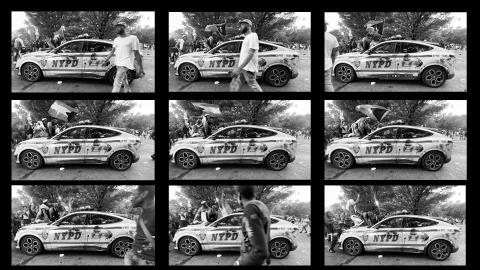
You watch your fellow Afro-Caribs mount a parked NYPD vehicle, a collaborative effort from your Bahamian, Bajan, and St. Lucian cousins. A couple of Jabs see the momentary insurrection and lend their signature motor oil on to the vehicle’s exterior, then scatter toward the congregation of Jab Jabs. You move closer to the car and realize through the oil smeared window that there is an officer sitting in the driver’s seat with hand to head tilted in resigned annoyance.
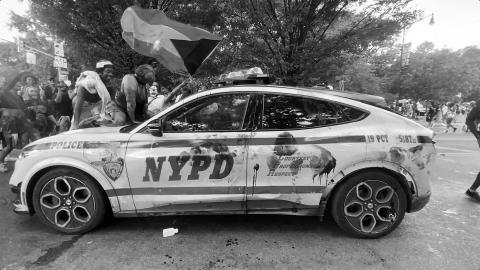
Ian Charles, a historian and founder of Jambalasee Grenada, relays, “Remember, you don’t have no gun, you have no knife, you have no bomb, you had nothing. So you have to use the intangibles right now to really resist.”10
You run after your kinfolk Jabs—black rabbits with smashed pocket watches—to eventually find your Capital: These are the leaders of the Jab procession that invoke the call-and-response chants known as “spellings.” The chants distribute historical and sociopolitical messages that maintain our oral tradition. These spellings—sonic vibrational recollections—remind us that through our tool of syncretism, it was rebellion and not bondage that we inherited, that the Quashie complex is a Trojan horse.
However, then, you come to be surrounded by black resin–coated yellow stars, orange, green, and red—we’ve made formation by becoming the Base, Le Coupé. Every year, I stick with my maternal heritage joining the Jabs, but always hanging from my back pocket is my paternal heritage, the red and blue drapo d’Ayiti.
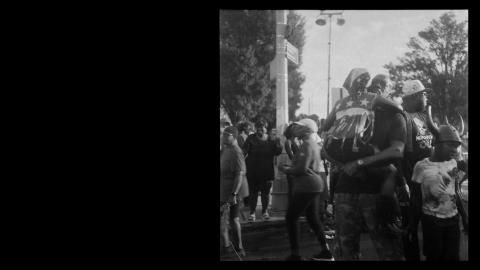
Bleue Liverpool is a Caribbean American intermedia arts practitioner. Born in Brooklyn NYC, she was raised by a Grenadian mother and a Haitian father. Her practice derives its influence from the fluxus tradition of Intermedia—utilizing video, analog film-photography and text, and new media techniques to illustrate anticolonial knowledge production; surveying Afro-surrealism, Tropical-Marxism / Bakuninism, anticolonial feminism, and queered diasporic movement(s), with sociocultural specificity in transatlantic dynamics shaped by Anglo-Franco colonization. She holds a Bard MFA in film/video. In 2018 she was the Mary Ellen Mark Memorial Scholar for New Media Narratives at the International Center of Photography, New York City, and in 2025, the annual Artist Fellow for the Stuart Hall Foundation, United Kingdom. She has exhibited at New Museum NYC, Museo Tamayo CDMX, and Berlin Art Week. Currently, she is a practice-based prospective in the dual doctoral training program at both Goldsmiths, University of London and Cambridge University (UK). Since 2021, she has been a monthly resident on Radio alHara.
[1] Claude Mckay, “Quashie to Buccra,” in Songs of Jamaica (A. W. Gardner, 1912).
[2] Collins English Dictionary, 2025, under “buckra [buccra],” https://www.collinsdictionary.com/us/dictionary/english/buckra. “Mbakara,” divide and rule, in Hope Masterton Waddell, Twenty-Nine Years in the West Indies and Central Africa: A Review of Missionary Work and Adventure, 1829–1858 (Cambridge University Press, 2011). Also see https://en.wikipedia.org/wiki/Mbakara.
[3] Kamau Brathwaite, Caribbean Man in Space and Time: A Bibliographical and Conceptual Approach (Savacou, 1974), pamphlet.
[4] Sharine Taylor, “The Transgressive Pleasure of Carnival,” Yes!, 2 December 2024, https://www.yesmagazine.org/health-happiness/2024/12/02/grenada-jab-carnival-pleasure.
[5] John Angus Martin, “Grenada’s Forgotten Heritage,” Grenada National Trust, 2019, https://grenadanationaltrust.org/grenadas-forgotten-heritage/. Grenada National Trust, “Djab Djab,” 2022, https://grenadanationaltrust.org/ich/djab-djab/.
[6] “The Parkway” refers to Eastern Parkway Boulevard, Brooklyn, New York City.
[7] Taylor, “The Transgressive Pleasure of Carnival.”
[8] Brathwaite, Caribbean Man in Space and Time, 3.
[9] Sylvia Wynter, “Black Metamorphosis: New Natives in a New World,” (unpublished ms., n.d. [1970s]), 134.
[10] Ian Charles, quoted in Natasha S. Alford, “The Revolutionary Meaning of Grenada’s ‘Jab Jab’ and Why More Black Americans Should Travel to Spicemas,” The Grio, 26 September 2025, https://thegrio.com/2025/09/26/the-revolutionary-meaning-of-grenadas-jab-jab-and-why-more-black-americans-should-travel-to-spicemas/. See Jambalasee Grenada, https://jambalaseegrenada.com/home.