1
Ingredients: Banana fiber, Yemayá, sugarcane left in the vat, Yallahs Pond water, her father’s woes, his mother’s prayer, cattails, a stray dog who never found his way home, his god, her god, our god, a new god, cerasee, Lake Michigan’s essence, and Bob Marley beach sand.
2
In the essay Kitchen Marronage: A Genealogy of Jerk, Tao Leigh Goffe posits the kitchen as a site of marronage.1 In Jamaica, Maroons are highly regarded as fugitive peoples who escaped enslavement and, in the bush across the African diaspora, lived among themselves in conversation with the environment. In Goffe’s text, she expands on a lineage of Black geographies where Maroons are positioned as a people who not only escaped but built more sustainable relationships with the environment. Through using the plants and produce in their surrounding areas, they resisted the colonial practice of bringing exported plant life to the islands and insisted, through foraging, that the existing environment was able to nourish and feed them.2
Goffe underscores the text with the way her learning how to cook Jamaican recipes became a mode of self-preservation. For me, cooking has always been a modality to care for myself and my loved ones. Recipes enable me to provide love and nourishment for my family. Despite my having grown up in a Black church, the kitchen is where I first learned a devotional practice.
“If the kitchen is typically an architectural enclosure,” Goffe argues, “the way Maroons embraced the rainforest as a kitchen is a form of Black spatial livingness in opposition to the containment of the nation-state.”3 In these earthbound kitchens, other forms of cooking transpire. For papermaking artists without traditional studios, the kitchen is the studio and is where fibers are cooked. Embracing the local ecology of Jamaica, particularly the southern parish of St. Thomas, has enabled the New Local Space Seep residents Kamala Davis and Sonn Ngai to embark on kitchen marronage through a practice of papermaking.
Kamala, Sonn, and I were among five participants that the New Local Space Seep residency in Kingston asked to consider reciprocity and its contemporary stakes in relation to Jamaica’s sociopolitical and ecological landscape.4 The question of ecological reciprocity particularly is one that Black feminists who explore Black ecologies and geographies, like Goffe, have considered through creative interventions. Kamala and Sonn cooked local materials like sugarcane, banana fiber, cattails, and galore in their kitchens, honoring a practice of conversation with the local ecology. The sheets of paper they pulled and pressed are imbued with a lineage of fugitivity and sovereignty. Within the residency, the earth became the ingredients; the Maroons, the cookbook; the kitchen, an enclosure for the creation of fugitive work. If water is an ingredient and an ancestral technology, how can we cook with it, and how can that cooking invite us to resist our shared colonial structures?
This residency has allowed me, as a writer of Jamaican descent, based in the United States and communicating with both artists and ancestors in Jamaica, to understand that recipes are conversations between us, the materials we cook with, and the ancestors we call on that coalesce into a physical being. Papermaking in Jamaica becomes an intervention into a terrain that suggests that imported food, materials, and spiritual practices have more value than the natural resources and customs of the island. It is a continuation of kitchen marronage. Through the making, artists ask where in contemporary Jamaica they need sovereign and fugitive space and practices.
At the time of the residency, the other residents and I were unaware of Hurricane Melissa, which in October 2025 would hit Maroon Town, a locus of New Local Space’s work, just a month after the residency had ended. Jamaicans are still in recovery from water’s violent intervention into their parishes from Hurricane Melissa. As kitchen roofs were blown off, and the kitchen literally became an outside enclosure, the impacts of climate change and its Western architects rose to the surface.
In Jamaica and in Chicago—where I am based and where I was rooted for the duration of the residency—the water, the forest, and the city are all contested landscapes in which Black individuals are subject to colonial and capitalist frameworks. Where water can be accessed in Chicago, which is located on Lake Michigan, has been impacted by systemic segregation in the city.5
In several Black diasporic traditions, the land and the water are imbued with spiritual connotations, revealed through mythologized beings like River Mumma, Mami Wata, Yemayá, or the civilization of Drexciya. These frameworks that obstruct one’s access to water not only impede one’s access to sovereignty; they impact their access to spirit. Rebuilding a relationship to land and water-based materials is also creating a relationship to spirit. Through kitchen marronage and papermaking, artists and writers alike continue a lineage of reciprocity demonstrated by Maroon ecologies, one where Jamaicans consider what they give and take from the land and water. Papermaking is a “Black geography” that invites us to build more reciprocal relationships to each other, our environments, and our spirit teams.6
3
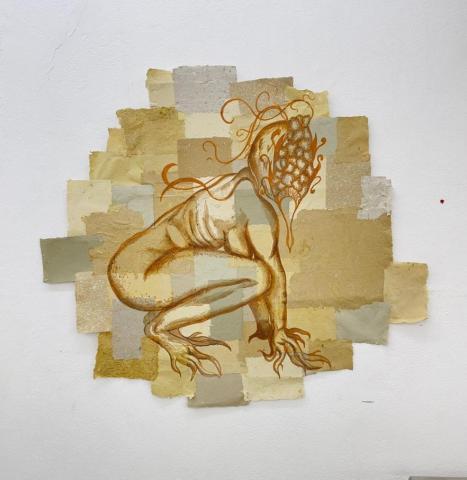
In omo: lure, Kamala Davis stitched together four-by-five-inch sheets of handmade paper (fig. 1). The work visually evokes the Jamaican patchwork tradition;7 and Kamala’s movement is embedded in the seams. As the stitches are revealed to us, we as a viewer understand the fragility of the material bound by them. The handmade paper sheets are a conversation between Kamala, her father, her father’s land, and her spirit team. They consist of materials that Kamala and her father foraged, like sugarcane and banana fiber.
Kamala’s father lives in St. Thomas, a terrain populated by sugarcane and banana plants, colonial exports that found a homeplace on the land. Though Kamala lives in Kingston, sojourns to St. Thomas are embedded in her practice, and the act of suturing these materials together also serves as a mode of suturing her relationship with her father, the landscape, and herself.
Kamala’s practice is a form of what Audre Lorde named biomythography. Through papermaking and drawing, Kamala merges African diasporic myths, personal and ancestral biography, and local histories.8 Lorde, a Caribbean diasporic writer, wielded biomythography to explore the ways fact and fiction can become blurred for diasporic and queer peoples. For Kamala, biomythography enables her to deepen her connection to her local ecologies and ancestors through mythologized versions of self. Her body as vessel and the handmade paper sheets as base, fantastical beings of her own creation are born. In omo: lure the figure’s face is an amalgamation of cerasee. Its hands are like tree tendrils, connecting it to the paper. Imbued in the being is Kamala’s spiritual practice that combines her herbalist work, African cosmology, and a deep connection to the natural world.
As a burgeoning herbalist, Kamala recognizes the ways plants like cerasee can be a healing resource. In several of our visits she shared her own recipes for plant medicine with me. This work as an herbalist is also a conversation with her father. The resulting work, a paper quilt of sorts, carries that conversation. In these sheets where cattails, milkweed, sugarcane, banana fiber, and calabash are conjoined, living together, unframed and unbordered, Kamala creates plant medicine, honoring the recipes she learned from her father and forming her own modes of healing in the kitchen.
In our first studio visit, Kamala shared her recent inquiry with papermaking. I was instantly taken back to graduate school and the papermaking course I took then. At the time, I was interested in making paper from sugarcane that I had gotten from Kingston and stored in my freezer. I intended to use that paper to create a book with a series of poems incited by the recipes of my maternal and paternal grandmothers. I made several sheets of a sugarcane-cotton blend, but I hadn’t quite found a space to move through it. The project remained in storage. The recipe remained in a notebook, waiting and breathing.
In conversation with Kamala, I realized that this sojourn I had started—this recipe that hadn’t yet found a soft place to land—was one I could share. Eagerly I told Kamala that I had created sugarcane paper and could send her the recipe. With my recipe, and with messages from her own familial and spirit guides, Kamala embarked on her own recipe making.
When Kamala cooks meals, she often lets her ancestors and spirits guide her. Rarely turning to instruction, she conjures meals that are representative of the conversations she has with the produce and with spirit. In the same way, the creation of her paper recipes was stewarded by text, material, and ancestor. The sugarcane paper recipe I shared had been in conversation with my own ancestral guides. Kamala turned to that same river of thought and ancestor, enabling her to create her own recipes specific to her geography. Though I was not there to physically share materials or watch the pot for her, I felt privileged to be able to share an inquiry of mine and constellate it with hers, engaging in a mode of reciprocity.
4
In the poetic text Dub, Alexis Pauline Gumbs moves through the suboceanic and spiritual realms, extending to her poetry practice the rigorous inquiry of the Jamaican theorist Sylvia Wynter. Using the ocean as a language and poetry as a tool, Gumbs creates poems that are an extension of what Wynter embarks on, named by Katherine McKittrick as a “creative-intellectual project of reimagining what it means to be human and thus rearticulating who/what we are.”9 Through this residency and this writing, I was interested in recipes as another extension of this creative intellectual project, in understanding recipe formation as a deeply collaborative process—a collaboration with material, writing, and spirit. When water is an ingredient alongside spirit and earthbound materials, recipes provide a framework for reciprocity. Cooking is an act of conjuring that enables Caribbean peoples to mythologize beyond colonization and into ancestral practices that sustains their ancestors and the landscape.
Gumbs reflects on the suboceanic in relation to the transatlantic slave trade. Not all African peoples captured made it to shore. Calling on the Midwestern mythology of Drexciya, Gumbs speaks to those unborn children of pregnant African women thrown off of slave ships by speaking and listening to the water.10 Through water she can access her ancestors who were relegated to an eternal afterlife underwater. Water is a Black geography, too.
Currently, Caribbean ships at sea are at risk of being bombed as they are mythologized as carrying drugs but have been, many times, carrying fishermen.11 Gumbs’s unearthing of African peoples thrown overboard at sea allows us to ask who, then, those fishermen will become once they are reborn underwater. Will they become surfaced in the vat Kamala pulls sheets from? Will those Africans thrown overboard in 1781 be reimagined in those reservoirs of sugarcane water?12
The artist residents Sonn and Kamala work in this lineage, continuing to inquire as to what aliveness lives in the water, in the backyard, and further, to inquire what rendering spirit as equal to human could offer us through multidisciplinary practices.
5
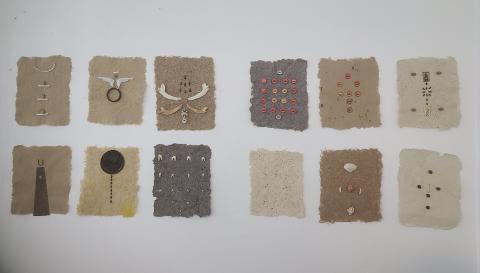
To make paper, my co-resident Sonn Ngai starts with gathering. Wading through St. Thomas, his residence and homeplace, Sonn finds his materials. He particularly finds respite by Yallahs Ponds, which like many terrains in Jamaica have mythologies embedded in the landscape.13 Finding materials like milkweed and calabash, he gauges their thickness and protein contents by sight, then soaks them overnight. Bringing those mythologies and his own relationships to the materials, his ancestors and the African cosmologies he studies, materials and spirits are stirred together. “Cooking isn’t the word,” Sonn shared with me in conversation. “I consider it magic, alchemy.” After soaking, the materials are blended, and he is left with a pulp, which he then immerses in a vat of water. From this pulp, sheets of paper are pulled. That brief baptism is a moment of submergence I want to pull focus on—the pulp in the reservoir, the body of water, and the physicality of surrender.
The act of baptism is a sacred one. In Christianity, baptisms are one’s entry point to salvation; when one’s body is submerged in the water, one becomes closer to God, closer to heaven. Christianity is the dominant religion in Jamaica, brought over as an import from enslavers, though not a religion any of the Seep residents participate in. Rather, Sonn finds resonance with Yoruba mythology, including the water deities like Yemayá.
Through that baptism, when Sonn lifts the mold and deckle out of the vat, with the pulp he brings Yemayá, river mumma, duppies, ancestors, Drexciya, and spirits who find home and salvation in the water. Wynter’s writing, in which Gumbs and Goffe root their work, suggests that new forms of humanism are possible and that those new modes are reliant on building a connection with the land and seeing nonhuman species in a nonhierarchical modality. This process of papermaking incited by Sonn and Kamala asks if those nonhuman species can include spirit, and if so, if they are a core ingredient in their recipes of reciprocity.
Sonn’s work uplifts these African diasporic spirits as a mode of familial healing (see fig. 2). By calling forth Yoruba spirits, Vodou spirits, and hoodoo spirits and challenging notions of those that are rendered as demonic through symbolism such as the snake, Sonn challenges structures embedded in Jamaica from colonialism surrounding gender and religion, structures insisting that men exist above women and that spiritual practices outside Christianity are demonic. Resisting the same hierarchies of humanness that Wynter identifies, Sonn’s water work through papermaking also unfolds as a mode of healing.
Wynter has named practicing multispecies kinship as an urgent need, particularly for Black individuals who have been rendered nonhuman under colonial metrics.14 I am interested in what multispecies kinship can look like if duppies and ancestors are also a form of species that we can foster reciprocal and generative relationships with.15 Through papermaking, Kamala and Sonn forge a relationship to becoming human that is rooted in kinship and reciprocity with the land and environment, a practice of kitchen marronage. The earth is the pulp, and the ocean is the vat, and from it, sheets of spirit fuse the deckle.
This is also a recipe.
This mode of water work and kitchen marronage asks of us, If a vat can be a bucket or basin, and mold and deckle a channel, can a lake be a vat? Can a sea? And when sheets emerge on the surface of the deckle, are they not conduits of those suboceanic beings, those ancestral harbingers?
6
For me papermaking is a form of surrender, a form of meditation, one where I am at the behest of the pulp and the water, the earth and the sea, and am asked to wait to see which spirits and ancestors will find their way to the surface.
During the residency, I learned from my aunt Denise of a relative, Isaac Barrant, a St. Thomas–born politician who worked in the Ministry of Agriculture and Farming. The material focus of his labor, as a banana dealer and later a worker at the Jamaica Sugar Estates limited, is directly referenced in the materials Sonn and Kamala engage with.16 Beyond that, his slogan, “Eat what we grow, grow what we eat,” speaks to the nature of recipe formation that I consider alongside Wynter, Gumbs, Lorde, Goffe, and the artists. This minister of agriculture and an ancestor of mine, a politician known in the community in the same birthplace as Kamala’s father and Sonn, was speaking to and through me without my even knowing him.
Such is the nature of ancestors and their communication. Sometimes it is not until we are fully submerged that we see them clearly, that they reveal themselves on the page, in the notebook or in the paper. Like Gumbs, Lorde, and Goffe, as a diasporic Caribbean with a hybridized identity I embrace hybridity as a form to shape a story of my relationship to ancestors and artists based in the Caribbean; our communications always seem to go underwater before they come to the surface.
As Wynter invites me to, and as my grandmother’s cookbook invites me to, in this piece I embrace hybridity. Spirits like Yemayá find homes in the water; they will swim away from you and back to you, sit with you and hit you in waves. Sometimes it is vast and uncertain like the ocean and sometimes it is fixed like a lake. These handmade paper sheets beg me to remember what it means to have a reciprocal relationship to water, my ancestors, and my geography.
Jordan Barrant is an interdisciplinary writer, a filmmaker, and a curator deeply vested in Black life. She is the recipient of a Fulbright Research Award and a Pulitzer Campus Consortium Fellowship, and has published writing in Burnaway, Variable West, and the Boston Art Review, among others. She received her BA from Spelman College and her MA from the School of the Art Institute of Chicago.
[1] Tao Leigh Goffe, “Kitchen Marronage: A Genealogy of Jerk,” The Funambulist, 27 August 2020, https://thefunambulist.net/magazine/politics-of-food/kitchen-marronage-a-genealogy-of-jerk-tao-leigh-goffe.
[2] On the colonial practice of bringing exported plant life to the islands, see Alex A. Moulton, “Towards the Arboreal Side-Effects of Marronage: Black Geographies and Ecologies of the Jamaican Forest,” Environment and Planning E: Nature and Space 6, no. 1 (2023): 3–23.
[3] Goffe, “Kitchen Marronage,” part 3.
[4] The Seep Residency took place in Kingston from July to September 2025. Four residents participated on-site; I completed the residency virtually in Chicago, where I am based.
[5] Like much of Chicago, beaches were historically racially segregated. Black Chicagoans faced violence and police interventions when visiting beaches northside. However, beaches now, particularly past 31st street, are spaces of communion for Black diasporic peoples. There, cookouts, birthday parties, family reunions, and more can be found dotting the shore every summer.
[6] See Katherine McKittrick and Clyde Adrian Woods, eds., Black Geographies and the Politics of Place (Between the Lines, 2007).
[7] See Jacqueline Bishop, Patchwork: Essays and Interviews on Caribbean Visual Culture (Intellect, 2023).
[8] The papermaker Kelly Taylor Mitchell also describes her practice as biomythography, situating her work in relation to the Brazilian Festival of Yemanjá. See Kelly Taylor Mitchell, “An Invitation: Ancestral Mapping,” Burnaway, 16 November 2023, https://burnaway.org/magazine/an-invitation-ancestral-mapping/#_ftn1.
[9] Katherine McKittrick, “Yours in the Intellectual Struggle: Sylvia Wynter and the Realization of the Living,” in Katherine, ed., Sylvia Wynter: On Being Human as Praxis (Duke University Press, 2015), 2.
[10] Drexciya was an electronic duo comprised of musicians James Stinson and Gerald Donald that originated in their homeplace: Detroit, Michigan.
[11] Morgan Phillips, “Trump Goes All-Out Against Colombia’s Petro after Claims Drug Strike Killed Fisherman: What We Know,” Fox News, 20 October 2025, https://www.foxnews.com/politics/trump-goes-all-out-against-colombias-petro-after-claims-drug-strike-killed-fisherman-what-we-know.
[12] Here I reference the Zong. See Catherine Baski, “The Story of the Zong Slave Ship: A Mass Murder Masquerading as an Insurance Claim,” The Guardian, 19 January 2021, https://www.theguardian.com/law/2021/jan/19/the-story-of-the-zong-slave-ship-a-mass-masquerading-as-an-insurance-claim.
[13] Yallahs Ponds is composed of two salt ponds. The ponds have been mythologized as twins who once shared the same space but fell out over a woman, causing the original pond to split in two. For more, see https://www.cabanenergy.com/en/resources/yallahs-a-tale-of-twin-ponds.
[14] See Sylvia Wynter, “‘No Humans Involved’: An Open Letter to My Colleagues,” Forum N.H.I.: Knowledge for the 21st Century 1, no. 1 (1994): 42–72.
[15] See Moulton, “Towards the Arboreal Side-Effects of Marronage.”
[16] See Marcia Thomas, “Remembering Distinguished Jamaicans—Isaac Barrant,” Jamaica Gleaner, 1 May 2022, https://jamaica-gleaner.com/article/art-leisure/20220501/remembering-distinguished-jamaicans-isaac-barrant.