La Vaughn Belle
Registers of Un-rememberings
Annie Paul encountered La Vaughn Belle twice this year. They met in-person at the artist’s St. Croix studio this past April, and they chatted again as Belle was installing "For the Love of Fragile Things," her solo exhibition at the Pace University Art Gallery in New York. In their exchange, Belle details how her research practices challenge the limits of colonial archives and contemporary "un-rememberings," and inform the beauty and tenderness of her visual creations. - Andil Gosine
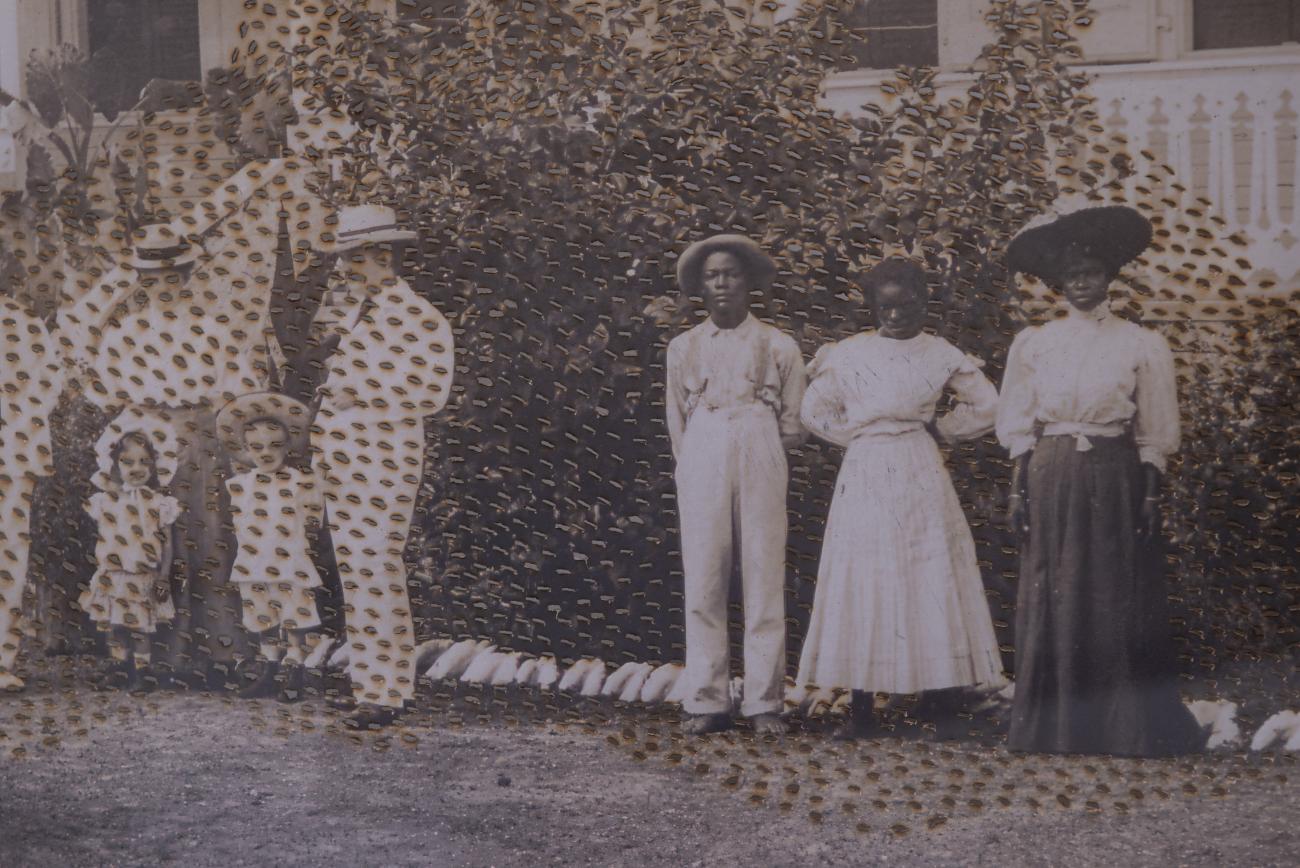
Annie Paul: Your art practice is such a capacious one encompassing traditional artmaking but also the acquisition and rehabilitation of history-soaked buildings and artifacts. Your very studio is one of these, and you have made deep diving into the Danish colonial archives an artform as well. I was fascinated by what you described as the malevolent gaze animating the Danish colonial archives, using metadata to find images of slavery, and having to navigate it indirectly by asking for images of ‘horses’ or ‘sugar’ instead of just ‘black people’ which yields nothing. But images of sugarcane or animals would invariably contain the enslaved bodies whose labour was crucial to both cultivation of sugar crops as well as the tending of animals. And voila! There were the subjects you were in search of. Can you tell us a bit more about this?
La Vaughn Belle: I think capacious is a great word. My practice comes from a deep engagement with place. I live in the US Virgin Islands on the island of St. Croix, a place that has been cut up into over 150 plantations or forced labor camps if we were to be less euphemistic. What this means is that most of the island is not “virgin” at all but has been severely and violently manipulated over the years by various colonial enterprises. We can include tourism in that too. But the most impactful and most visible manipulation is from the slavery and Danish colonial period. The remnants of sugar mills and other buildings, the gridded colonial towns named after Danish Kings, the ruined so-called Great Houses. We lived in these structures and yes as you mentioned I have purchased and renovated a few of them and my practice is deeply impacted by that experience.
I started my first renovation in 2011 which gave me deep connections to the architecture, the narratives embedded in these structures. And this helped me to begin to develop a narrative authority that countered the ones I found in institutional archives. The work you are referring to in which I was looking specifically for archives that had Black people in the images is a series called Swarm.
I should mention that the Virgin Islands is in a unique position with our colonial records. When Denmark sold us to the United States in 2017 and left, they took most of the institutional archives with them as well. So, we have been a community without our archives, which are mostly housed in Danish institutions, even our indigenous artifacts. Around the 100-year anniversary of the sale, Danish institutions began trying to digitize and make these records available online, so what I was describing to you was the process in trying to navigate that system. It’s not Google. The digital archives mostly replicate the colonial systems and hierarchies, so if you are trying to find images of Black people, yes, you have to look for a horse or sugarcane.
AP: I was also fascinated by the pyrographic pen or tool you used to work on the prints you extracted from the colonial archives. Systematically burning and stabbing patterns on and into the images, adding texture and marks to evoke other responses than those the photographer in question and the archivists might have had. What was the inspiration for such mark-making?
LB: In the same Swarm series, I used a vocabulary in my practice that I started developing in 2016. I had already had my first trip to Denmark in 2008 for a two-month residency. I spent a lot of that trip searching for where the Virgin Islands was in the Danish story. I had mistakenly thought that the visual evidence would be everywhere, like it was in the Virgin Islands. But instead, you had to really look, it was more invisibilized...like an active un-remembering submerged in the bricks. At the end of that trip a woman invited me to the Danish National archives housed in a library called the black diamond. She was researching the photo albums of families who had lived in what was called the Danish West Indies. It was fascinating as I had never seen these kinds of images before, and inside the construct of a photo album, the stories and images were riveting.
I spent the last few days of my trip in that library, totally obsessed. And as I spent more time in Danish colonial archives I began to learn their narrative devices, how they told the story of their triumph, how they listed their objects of value, who they placed in images and next to what, and began reading the subtext in these arrangements. It became clear who had the power, who was the master, who was to be managed, and worked and so on. Our stories were often absent or distorted to align with their worldview. This started me thinking about how I could develop an equally powerful visual vocabulary to tell our stories.
I thought about resistance, and rebellion and how these manifested in the physical world. Like, what were the tools used, or, how we may still see traces of rebellion, in our architecture. For example, on St. Croix, we have twin towns, Christiansted and Frederiksted, with the same gridded structure and same names on the streets. But the reason Frederiksted looks slightly different is because in 1878 large parts of it were burned down in a labor revolt called the Frieburn. I started noticing the tools used in rebellions, such as fire, and cutlasses or cane bills, the tools the formerly enslaved worked with, and I started to look for ways I could incorporate these into my visual language as another form of record.
So, I first started with the pyrography tool you saw in my studio, a pen with a blade that can also make burn marks and if you leave it too long on the paper, can indeed move from ember to flame. I started first using the design patterns from the town of Frederiksted post Fireburn. And later using them also in the Swarm series to transform the colonial photographs.
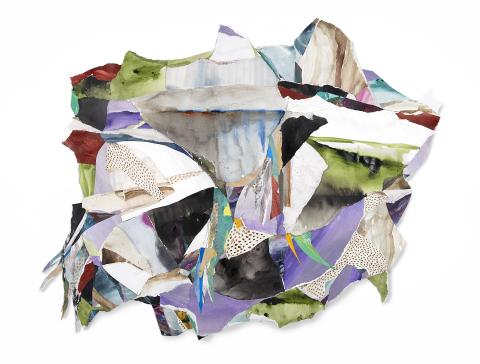
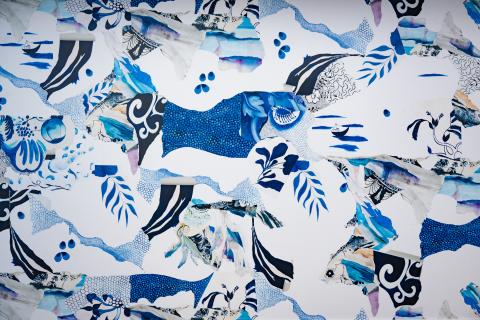
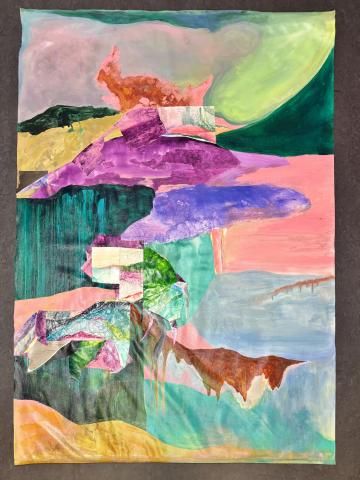
AP: The work you're showing at the Pace University Art Gallery this month was in progress at your studio when I visited. Although these are paintings, they suggest collages, looking like fragments assembled to suggest colorful landscapes appearing to bleed, pour, dribble and drool into one another. Tell us more about this technique and what you're trying to say in this new work.
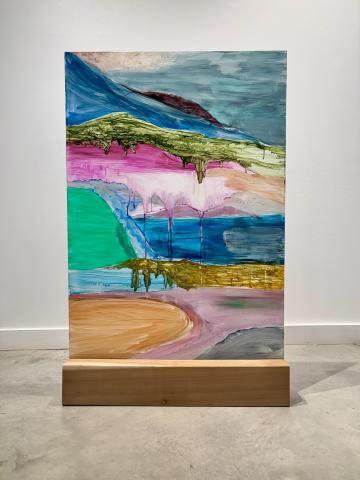
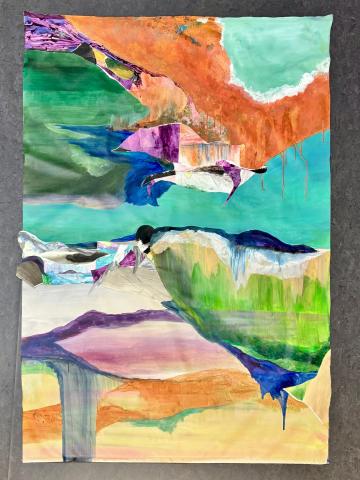
LB: I am currently in NY and have been here since mid-July. I have been an artist in residence at Pace University culminating in my first solo show in New York. I started this interview by mentioning place. A lot of my work comes from questions around how to navigate this place, and by place I mean, this time pastpresentfuture, this horizon, this island, this psychoterrain of coloniality, these fragments, this ruin. The Swarm series is about how to navigate the place that is in those photographs, my Cuts and Burns series is how to navigate the place constructed in the archives, my Chaney work is about how to navigate what it means to live in the fragments, and my current work is about how to navigate all of those things using painting. My practice is multidisciplinary because I look for the form that will help me best navigate the inquiry. So, I've been thinking less about countering colonial archives, and more about what would it be to create my own maps, myths, monuments even.
The work in this show, titled "For the Love of Fragile Things," consists of two new bodies of work. The first one, Mapping a Ceaseless Becoming, looks at first glance like an abstracted landscape, but I would say it’s closer to a map. They are in vertical formats, hanging like scrolls, and yes, they are quite colorful. Their color is like memory, in that they are more about feeling and associations. So, the color is an algae that you might see around a drainpipe, and the brown is the grass during drought, the pink is the inside of a conch shell, and the blues are sometimes the sky and sometimes what I imagine the deepest ocean floor might be, even though I haven't been there. And none of the colors is faithful to its origin, meaning that the land can be pink and the sky green. But in addition to the color what is also striking in this work is the construction of the image. There is no single horizon, sometimes you are inside the ocean, or looking down from the clouds, sometimes the perspective is from land and sometimes it’s from the sea and they often drip, drift and collide into each other.
I also collage into these works, torn, cut pieces from other paintings. They provide evidence of a rupture, another time and place. I am thinking about the mythology about what islands are, which is that they are detached and floating, even though they are really mountain tops. And I'm thinking about using that myth to activate a particular kind of terrain. In a way I am making a world where islands collide, and scamper, they have tendrils and talons, and the body is just as much present in this work as it is absent.
The second body of work, Between the Storm and the Horizon is also new. They are stand-alone works on plexiglass upheld by cedar bases. These are very experimental as I'm learning how to paint on a transparent slick surface. I find what's really different about it, is that there is evidence of every mark. On one side of the plexiglass, even if you paint over something you will always see the original mark, it's like a strata, or sediment, a kind of geology. I'm excited about this work, even though there’s a kind of vulnerability in making them because there are no do-overs, no real edits. Realizing this has been helping me think through the production of history in a new way.