sx art 9
-Home in a Space Left Behind (Various Artists)
DIVERSIONS
In 2025, a group of diasporic Indo-Caribbean artists were featured in Home in a Space Left Behind, an exhibition organized by Sarojini Lewis that brought work to Bihar, India, by artists whose ancestors' journeys toward becoming indentured workers in European colonies in the Caribbean likely began there. Priya Swamy, Curator of Globalization and South Asia at the Wereldmuseum in Amsterdam, offered some reflections about her engagement with Home during her visit to the exhibition. -Andil Gosine
Only after I landed in Bihar, India, did I realize that Home in a Space Left Behind, an exhibition that reflected on Indo-Caribbean legacies of indentured labour, was going to be exhibited only a ten-minute drive from the holiest Hindu river in India—the Ganges. While I worried this location may be framed within one-dimensional notions of ‘homeland’ or ‘authenticity,’ the works spoke to something much bigger: the silences, forgotten stories, or overlooked materialities that transform and render things anew in diaspora contexts.
As curator of Globalization and South Asia at Wereldmuseum, the Netherlands, I am confronted through my work with the colonial logic of collecting from ‘authentic’ spaces, as Indo-Caribbean material culture was not always seen as worthy of collecting, since it was viewed as coming from an inauthentic, off-centre diaspora. To push back against this, I have thought with Édouard Glissant’s theory of the détour[1](diversion), where different ways of speaking, writing, and thinking become ways of resisting what is imposed on material culture by colonial modes of classifying and creating knowledge about it.
My work has also taken inspiration from the Guyanese English author Pauline Melville’s prologue to her novel The Ventriloquist’s Tale. Her novel about a Wapishana family in Guyana’s savanna and their encounters with colonialism in the midst of indigeneities mobilizes Glissantian diversion in its resistance to the written word and linear histories. That museum preservation and documentation might not be desirable or appropriate for forms of Caribbean material culture is best summed up by the novel’s narrator, Macuniama: ‘No one round here likes measurers, collectors, or enumerators. We cannot hoard in the tropics.’[2]
In the context of the Bihar Biennale, I see diversion as an especially radical practice. While on the one hand it overturns the colonial logic of the museum, it also dismantles current narratives of essentialized global Indian identity.[3] These two projects are entwined: it is the colonial logic of the British that put in place many of the ideas around essentialized Indian identity that are now pushed by postcolonial indigenous stakeholders. Indian diaspora communities, including in the Caribbean, are being courted to participate in a version of Indianness that promotes so-called upper-caste Hindu practices and values. This creates historical, social, and religious distance from its minority communities and their lived experiences, even though they make up the majority of the population. Authenticity is a large part of this narrative as well: who are the original inhabitants of India? What religion came first?
Curator-artist Sarojini Lewis constructed the concept for Home in a Space Left Behind (HSLB) around her own inquiry into how the legacy of indentured labour has been dealt with through recent works of art, and how we may understand the particularities of this oeuvre of work, and its potential for historical critique. Ten artists—Andil Gosine, Tamara Hartman, Kevita Junior, Ruby Joemai, Ranjeeta Kumari, Sarojini Lewis, Maya Mackrandilal, Umesh S, Preeti Singh, and Raqeebah Zaman—brought their work to the space in Patna, Bihar. In the vein of Glissant and The Ventriloquist’s Tale, the works in HSLB divert collections and archives. They focus our attention on side stories, minor characters, or miniscule ephemera. HSLB turns to glances, disabilities, or embodied experiences to illuminate a richness that would otherwise be classified as mistake, loss, or inauthenticity. I was particularly moved by three artists—Tamara Hartman, Nazrina Rodjan, and Sarojini Lewis—who all engage in complex acts of diversion through their work.
Diversion 1: ‘It takes more than one life to make a person’
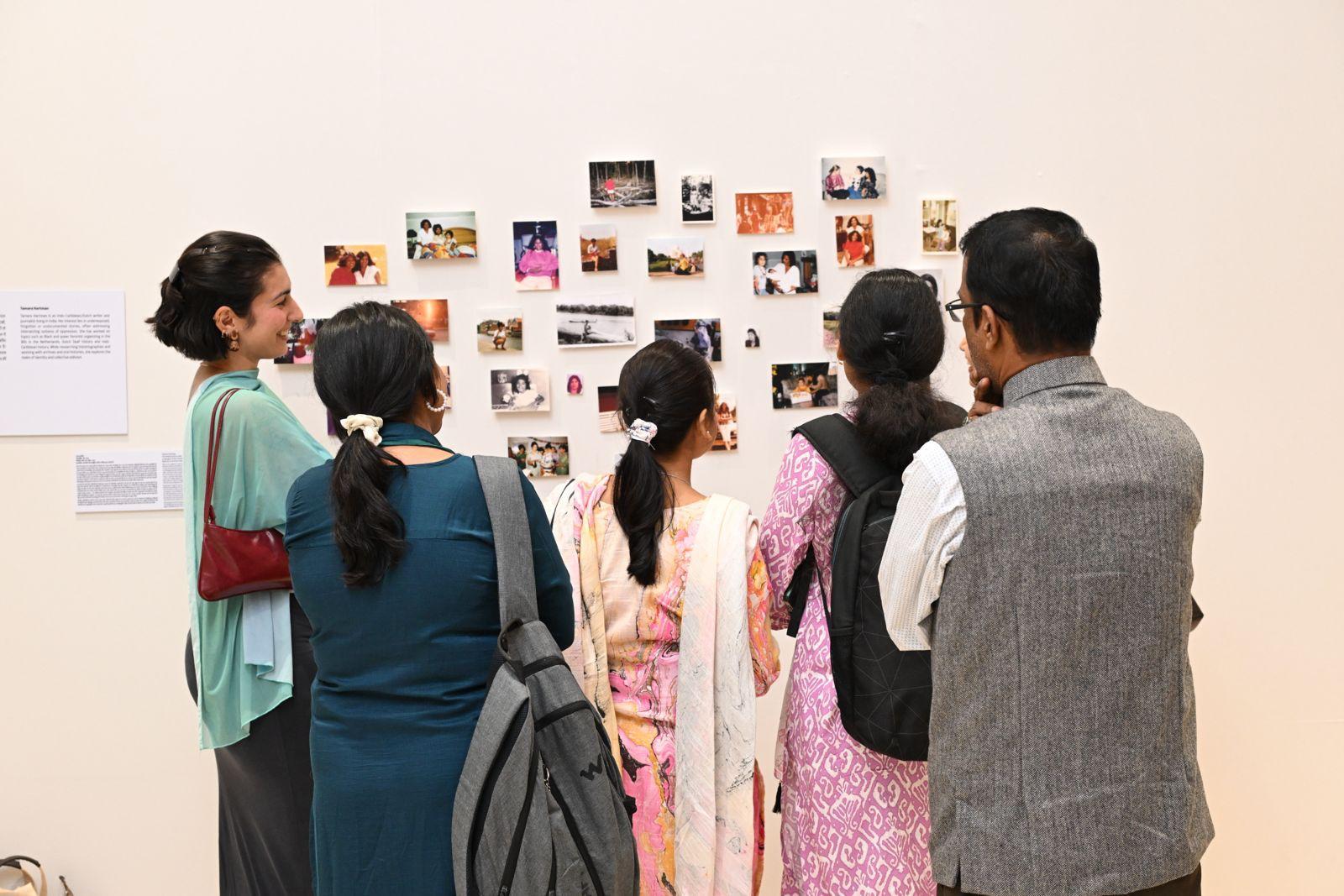
Macun’s grandmother spurned the idea that people stand independent in their own histories. They are instead endlessly entangled with those around them. Tamara Hartman temporarily affixed her own entanglement to a gallery wall. Hartman works as a journalist and author, whose installation Languages of Not Knowing focuses on her relationship with her mother and grandmother as they navigate life in the Netherlands through the lens of immigration and disability. Both are Surinamese Indo-Caribbean women: her mother Bhagjwatie, is Deaf, and her grandmother, Ishwarie, had early onset Alzheimer’s. This meant that communication across generations was limited, and eventually impossible. In her childhood, Bhagjwatie would communicate with Ishwarie using their own created sign language, also called a home-sign. After she and her mother came to the Netherlands when Bhagjwatie was six, Bhagjwatie went to a Deaf school in the Netherlands and learned a dialect of Dutch Sign Language—a language that together with other sign languages was heavily marginalized and discouraged within education until 1980. [4] Her grandmother did not learn Dutch Sign Language, which made it difficult for Ishwarie to teach her daughter about the religious practices or rituals that she saw happening around her. While Hartman and her mother had Dutch Sign Language to communicate, Ishwarie’s deteriorating health meant that Hartman could not ask for stories or explanations about her history, or about those same rituals that eluded Bhagjwatie. What was left were the pictures in the carefully maintained archive by Bhagjwatie.
Diversion 2: ‘Because these days you have all forgotten how to make heroes’[5]
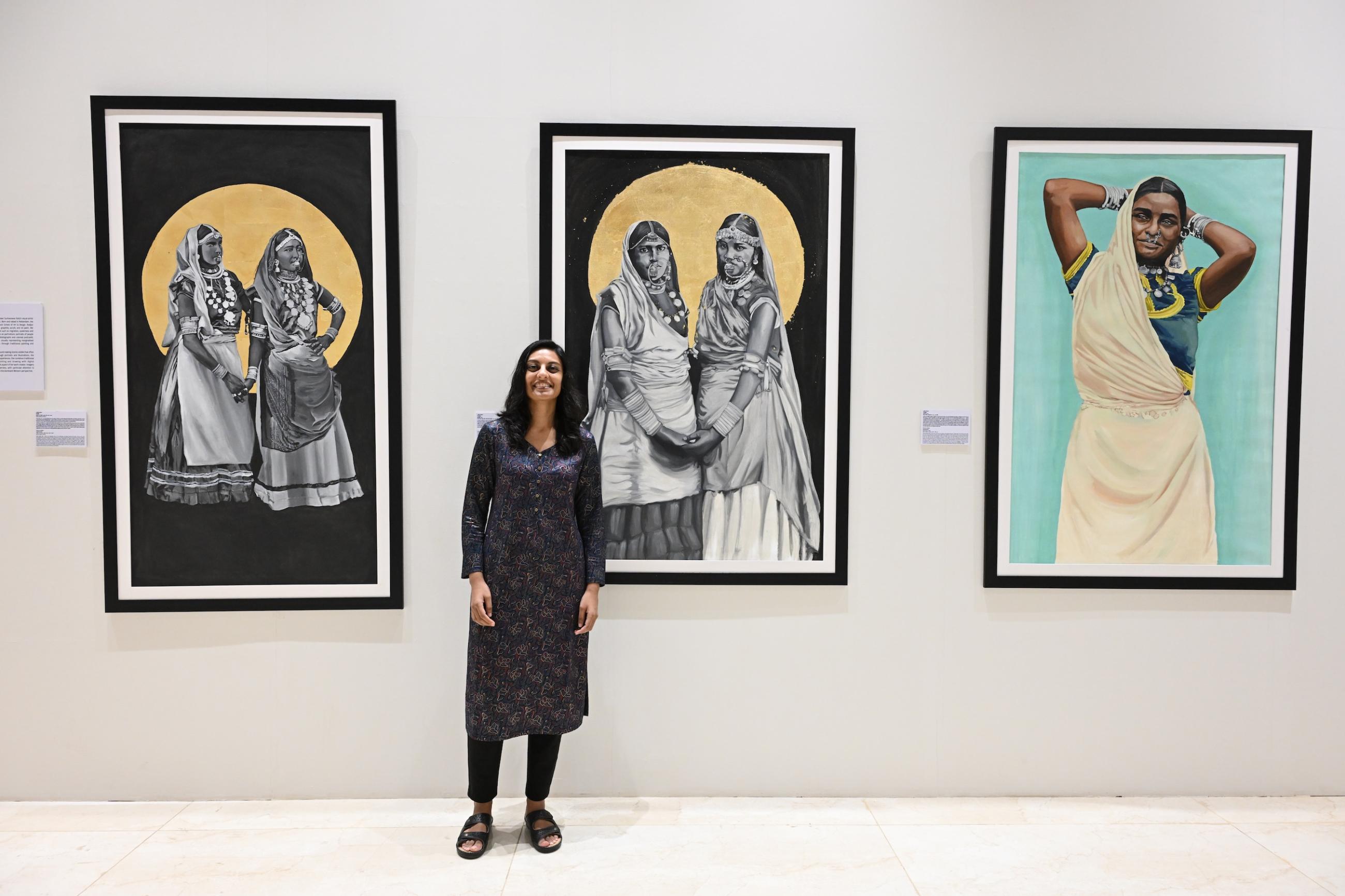
Macun scathingly denounces history’s choice of heroes. What of the victories of those who refuse to live lives that others have constructed for them? Nazrina Rodjan works primarily in oil and graphite, illustrating queer intimacies, migration, and diaspora. Her four portraits from the 2023 series Kala Pani: 1873-2023 are grand-scale, a response to nineteenth- and twentieth-century postcards featuring Indian women in the Caribbean. Flimsy and fungible, they share more traits with a deck of cards than portraiture. Instead, Rodjan inscribes them in opulent colour, reminiscent of seventeenth-century Dutch aristocratic painting. Departing from the humble question of who these women were, Rodjan reimagines their everyday life in the face of exploitation. In her piece Tu tani se lage hai hamaar jaise (You look a little bit like me), she considers the traces of romance between the two unnamed women to highlight the new bonds that may be formed on the plantation, where the site of exploitation may also open up possibilities for comfort and joy. While the original postcard image may appear staged, Rodjan reads gaze and body language to divert the narrative. She places women in radiant moonlight, as if they are taking a leisurely stroll. Standing close, they hold hands, and look directly forward—their gaze meets the viewer with an assuredness. Rather than a fantasy of the finely adorned Indo-Caribbean woman, Rodjan’s women are imagined as having a life worth living. What is more, Rodjan imagines her own proximity to these women, who could have been her ancestors. By showing them sharing love, she opens up the possibilities that her own family may have found comfort and intimacy in their lives—a small victory against a large history.
Diversion 3: ‘Writing things down has made you forget everything’[6]
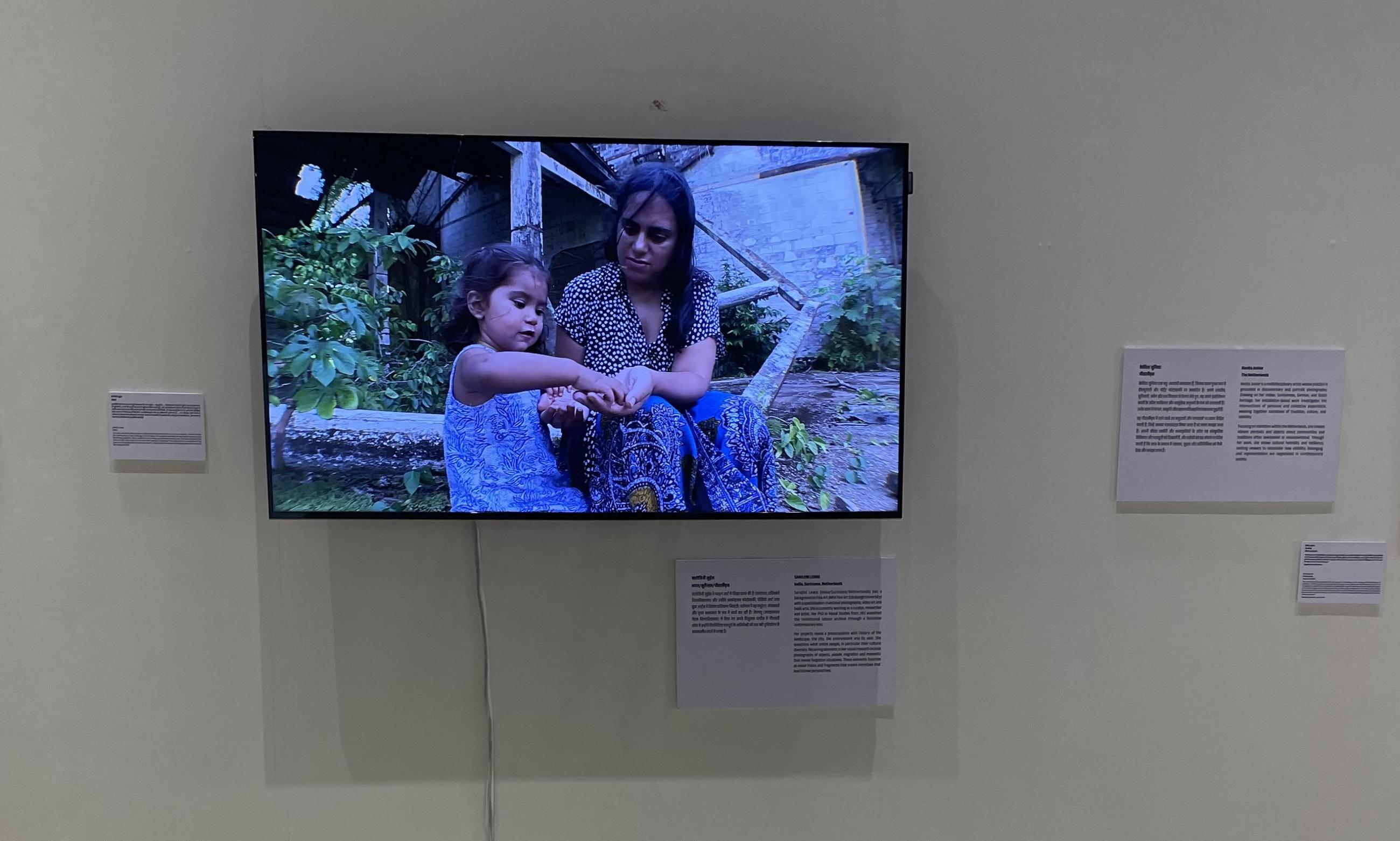
Macun laments our obsession with the written word. Histories and ancestries only become relevant once they are inscribed. Sarojini Lewis’s work similarly moves away from what is written to examine how histories are felt in the bones. Lewis is a multidisciplinary artist whose work uses her own body as an archive of experiences inherited and reimagined. For what remains unspeakable or unwritten, she turns to what is felt and enacted through mundane bodily acts like touching or walking. Adding attributes to her body, like coloured powder, or an orhni (a white lace veil that older Indo-Surinamese women wear during religious rituals or as they get older) move her into deeper conversation with her lineage. In recent years, her relationship with her daughter has increasingly featured in her work.
The unnamed video installation in the exhibition is a reenactment of Lewis’s ancestor, Dhannu Munnia, who departs from India to Suriname at the age of twenty-four for the Mariënburg plantation. The shots feature Mariënburg’s landscape, now empty and overgrown. In this eerie space, her daughter, at some points adorned with an orhni, winds through the space as if running through a maze. Her sporadic squeals of joy divert the audience to experience the inextricable bond between Lewis, her daughter, Dhannu Munnia, and Mariënburg. Dhannu Munnia’s contract still exists as part of the written archive. However, throughout the film’s scenography, Lewis reminds us that it is perhaps through her daughter’s unsure gait that Dhannu Munnia’s life is best appreciated, rather than what details of her life cover a single sheet of paper.
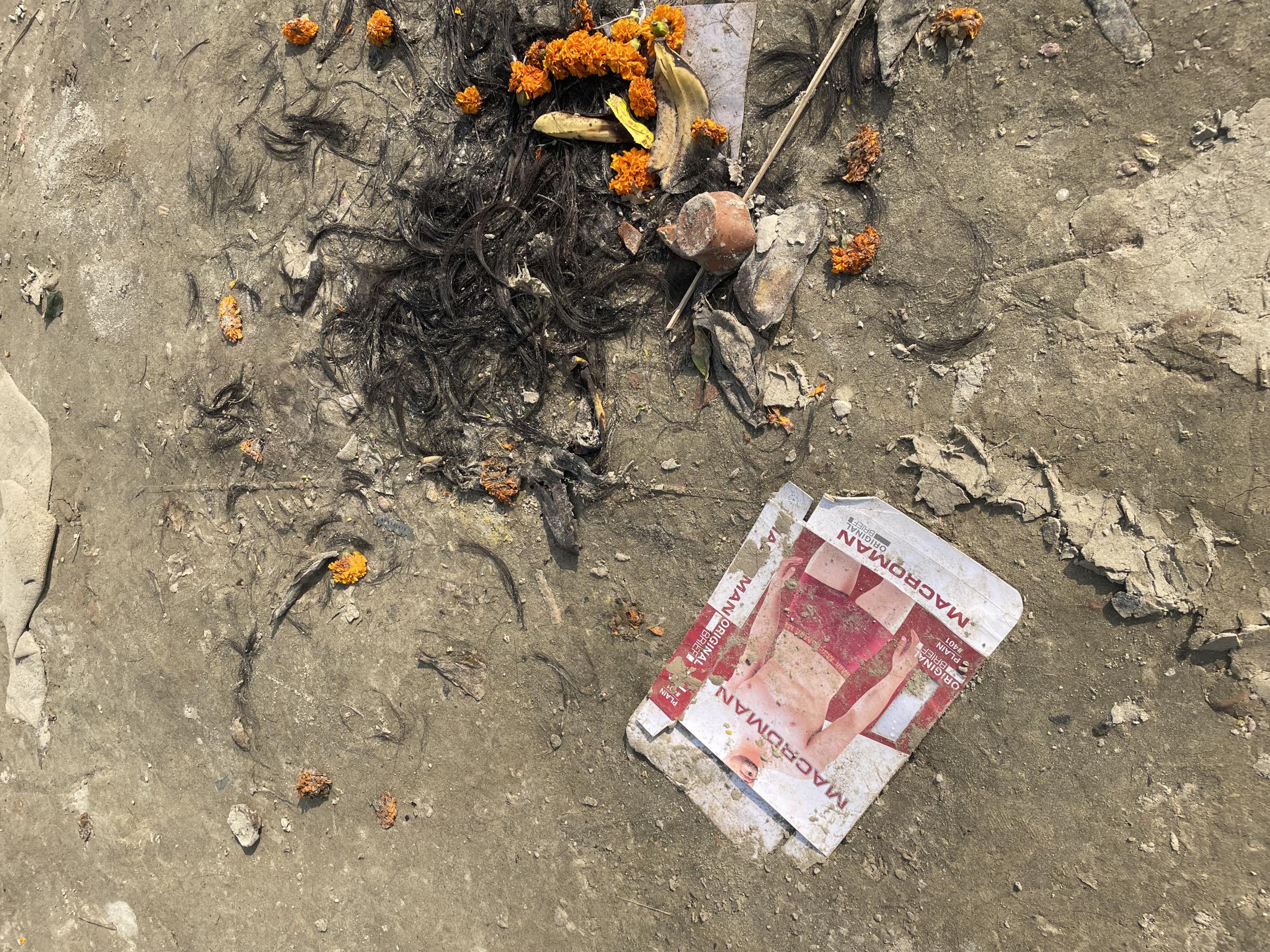
On the opening day of the group show Home in a Space Left Behind, Tamara Hartman, Nazrina Rodjan, and Kevita Junior and I took the ten-minute detour to the Ganges. We walked slowly along a bank, looking at the great expanse of water before us. Littered everywhere was the detritus of rituals past: pictures of goddesses, flower offerings, even an empty package of men’s underwear (I like to think that a fresh pair was needed after bathing in the river). The scattered pieces reminded me that there are things that were never meant to be preserved, collected, or counted.
[1] Édouard Glissant, Caribbean Discourse (Caraf Books, 1989). Trans. J Michael Dash.
[2] Pauline Melville, The Ventriloquist’s Tale (Bloomsbury 1997), 2.
[3] I have written previously on global Hindu identity in the twentieth and twenty-first century, see Priya Swamy Struggles for Hindu Space in The Netherlands: Affect and Absence (Bloomsbury 2025), 135-155.
[4]The Milan conference in 1880 was a watershed moment when mostly non-Deaf scholars decided that Deaf people should try to conform to society by learning to read lips rather than use signs. This moment was taken forward by many European countries to discourage or refuse to use sign language within education in the name of assimilation and integration. For more on the marginalization and oppression of (sign) languages, see Languages of Not Knowing, accessed 30 April 2026.
[5] The passage goes on to laments that heroes today lack any sense of wonder or playfulness. Melville, 2.
[6] Ibid.