Review of Sophie Rivera: Double Exposures
Review of Sophie Rivera: Double Exposures
by Rocío Aranda-Alvarado
Sophie Rivera: Double Exposures at El Museo del Barrio is a much needed and long awaited retrospective of the photographer's work. Active from the late 1960s through the early aughts, Sophie Rivera is a key figure of the Nuyorican arts movement of the 1970s and 80s, lending her sharp photographer’s eye to a beautiful variety of portraits and street scenes, all unmistakably of New Yorkers in the glory of their urban environment.
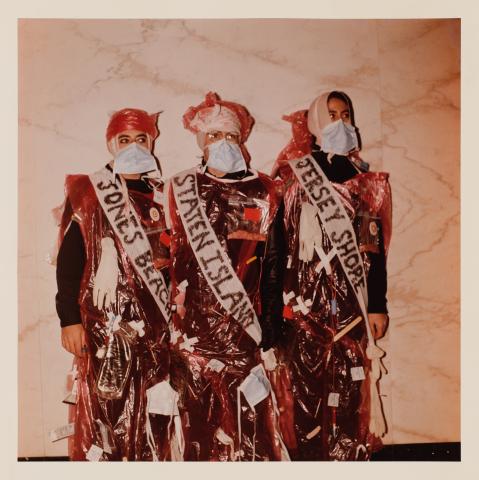
Perhaps the most gratifying surprise in the exhibition is the group of Halloween portraits Rivera took during the traditional Greenwich Village Halloween parade (c. 1986-87). This grid of large color photographs highlights several of the artist’s most traditional ways of working, including catching people in the moment and asking them to pose as-is for her lens. The images unveil the truly creative nature of New Yorkers and the amazing costumes they fashioned from ordinary materials, long before widely-available and inexpensive plastic and polyester costumes could be shipped to one’s home. One of the best examples is a group of three young women covered in transparent pink plastic bags with rubber gloves, syringes, face masks, and ziploc bags filled with unidentifiable “medical waste” attached to them. The final touch is the three beauty-queen style sashes they wear that read “Jones Beach,” “Staten Island” and “Jersey Shore” (🤣).
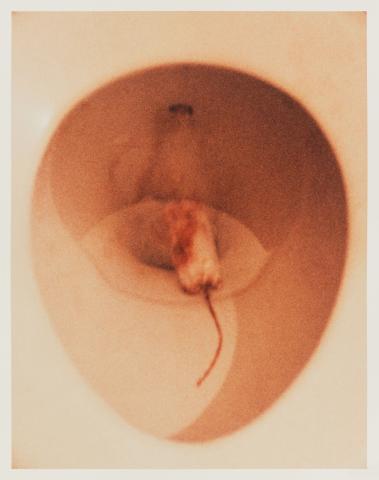
Her penchant for the abject and her feminist lens also led her to create a series of photographs of a toilet, sometimes featuring a discarded bloody tampon, sometimes presenting human waste. Installed as a grid in the exhibition, the elegantly titled Rouge et Noir (1976-78), offers an unexpected view of a woman’s excretions and makes reference to so many other historic works of art that evoke toilets and related content, not to mention, bathroom humor more generally.
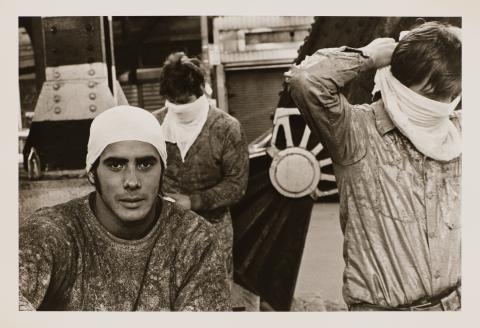
Rivera got her start working for leftist publications like the Liberation News Service in the late 1960s. Her perceptive eye and progressive inclinations led her to document protests over the Vietnam War, the New York City Department of Education, the cancellation of a Latinx focused television show from public media and other scenes. Her training with the noted street photographer Lisette Model is evident in these kinds of images and a host of others that show, for example, MTA workers painting the overpass bridge of the number 1 train.
This will to show regular folks in ordinary circumstances also led Rivera to the interior of the NYC Subway, featuring a host of people on their daily rides. Mothers and children, the unhoused, graffiti artists, regular New Yorkers are all presented with dignity and tenderness.
Among the most well-known works in the exhibition is the monumental series titled Latino Portraits, which have been the most shown and most collected works by the artist. Rivera gathered these individuals in the hope of showing a group of Latinx “archetypes,” that were generally missing from all media, including books, magazines, films and television
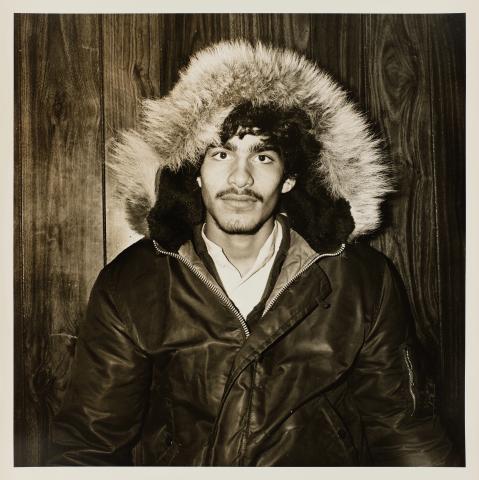
This invisibility that the artist tries to counter is the main drive of her work and underscores her sensitivity to her subjects and their appearance. The large-scale images have now been acquired by the Smithsonian American Art Museum, the National Gallery of Art, and the Whitney Museum of American Art. In this way, they have managed to complete the task that Sophie Rivera set out for them, to highlight representation in a way that is both unassuming and proud, featured in the velvety light and dark, black and white of her gelatin silver prints. Shown in 1989-1990 in a Bronx subway station under the auspices of the Public Art Fund, they underscore the “belonging” of these subjects to their community but also to the larger world of “art.”
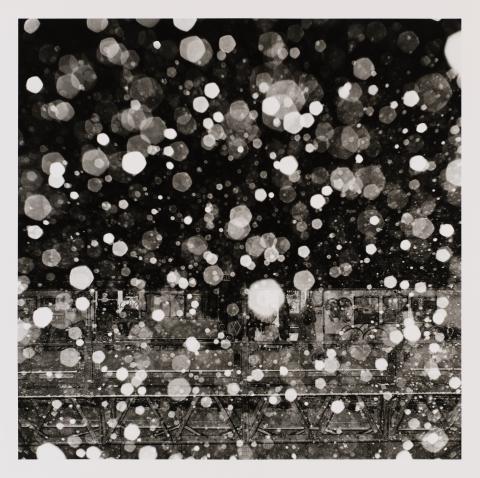
I end with one of the most beautiful images in the exhibition, of falling snow [Fig. 5]. The attempt to take such an image is nearly impossible for an untrained photographer. Rivera’s image is magical, with subtle layers of glowing, fuzzy, sparkly dots of snow in all different sizes. It is yet another example of the unexpected, the beautiful, the quotidian as presented by this artist with loving care. For Puerto Ricans on the island, the magic of a snow falling from the skies is unknowable. For Nuyoricans like Sophie Rivera, it presents another chance to capture a lived experience in a singular and poetic image.
Sophie Rivera: Double Exposures through August 2, 2026 at El Museo del Barrio (1230 Fifth Avenue, East Harlem, Manhattan). The exhibition is organized by El Museo’s Chief Curator, Susanna V. Temkin, and is accompanied by a color catalog published by Aperture, available at El Museo and online.
Rocío Aranda-Alvarado, is an art historian and a curator and is currently a Senior Program Officer in Arts and Culture at the Ford Foundation. She worked for nearly 10 years at Jersey City Museum, where she organized an exhibition of Sophie Rivera’s large portraits and another 9+ years at El Museo del Barrio. Her curatorial work and research explores modern and contemporary art of the Americas, with a focus on US Latinx art.
@artyrocio @100latinxartists