Reading the Caribbean as an Ecological Archive in Land. Sea. Sugar. Salt.
Reading the Caribbean as an Ecological Archive in Land. Sea. Sugar. Salt.
Witnessing: About the Exhibit
In “The Sea is History,” Derek Walcott challenges the idea that history resides solely within written archives and monuments when he writes, “Where are your monuments, your battles, martyrs? / Where is your tribal memory? Sirs, / in that grey vault. The sea. The sea / has locked them up. The sea is History.”1 Instead, Walcott identifies the sea as an archive, suggesting it is here that Caribbean history is preserved through movement, sedimentation, and its entanglements with land, bodies, and ecological life.
The phrase “writing in water” usually refers to something temporary or impossible to preserve. However, the exhibition Land. Sea. Sugar. Salt.: Terrestrial and Aquatic Contemplations of the Caribbean, which was on view at the Art Museum at the University of Toronto from 25 February to 1 August 2026, urges viewers to rethink that assumption. Water remembers: Rivers, oceans, canals, and coastlines carry histories of slavery, indentureship, imperial trade, migration, ecological transformation, and resistance across generations. If Walcott relocates the archive to the sea, Tao Leigh Goffe extends this insight by demonstrating that Caribbean ecologies constitute material records of racial capitalism and colonial modernity, noting that “the vibrations and shock waves of the climate crisis are written in stone, absorbed over the course of geologic time dating back more than four billion years.”2
Curated by Michelle Jacques and Sally Frater, Land. Sea. Sugar. Salt. invites onlookers to read Caribbean environments as living archives through which colonial histories remain embedded (fig. 1). The exhibition brings together work by artists with familial ties and lived experiences in the Caribbean who explore histories of land, water, colonial extraction, and environmental precarity. These artists include Alexandre Arrechea, Charles Campbell, Carolina Cayedo, Giana De Dier, Braxton Garneau, Deborah Jack, Las Nietas de Nonó, Hew Locke, Farihah Aliyah Shah, and Kara Springer. Composed of videos, installations, and photography, this exhibition emphasizes how Caribbean communities continue to resist, adapt, and create in the wake of colonial legacies, climate change, and struggles for sovereignty and environmental justice.3
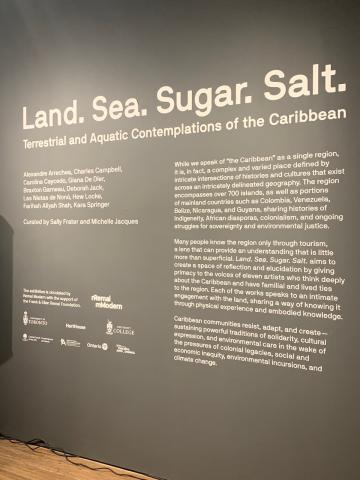
How does an art exhibition teach us to read the climate crisis in the Caribbean? To answer this question, I examine Charles Campbell’s Bagasse (2009); Giana De Dier’s Untitled (Sunday’s for tending the garden no. 2) (2021); Braxton Garneau’s Pay Dirt (2025); and Farihah Aliyah Shah’s Always About Land (2023) and A Garden for Lucille (2026). Taken together, these artists visually narrate the ongoing climate crisis in the Caribbean shaped by colonial infrastructures and diasporic memory.
This guiding question extends to my own experiences. I departed Jamaica a few days before Hurricane Melissa made landfall in October 2025. Many parts of the island continue to be affected by its aftermath. As I finished writing this essay in July 2026, the sky was gray and tinted orange over my neighborhood in the Greater Toronto Area from the severe wildfires engulfing Namaygoosisagagun First Nation (Collins First Nation) about two hours away. On 15 July, the Anishinaabe artist Nadya Kwandibens (@_anishinaabekwe) posted on Instagram: “My family hometown, Collins Ontario, is GONE.”4 These harrowing realities remind me that the environmental concerns raised by Land. Sea. Sugar. Salt. are neither distant nor abstract. They are unfolding across different geographies with distinct histories of colonialism and environmental precarity. Rather than presenting climate change as an isolated contemporary crisis, the exhibition reveals environmental vulnerability as the continuation of colonial systems whose effects remain embedded within Caribbean landscapes.
Remembering: Ecologies as Archive
In Land. Sea. Sugar. Salt. remembering is an ecological process where landscapes and waterscapes store and transmit history. Farihah Aliyah Shah’s Always About Land articulates ecology as an active archive shaped by migration, familial inheritance, and colonial displacement (fig. 2). Shah’s three-minute video features the Demerara River and the surrounding landscape highlighting how colonialism and imperialism have shaped Guyana’s environment. The video is accompanied by a voiceover by O’Keefe Shah (the artist’s father) reflecting on “how the colonial project renders people as impediments to progress; how humans and animals are displaced in the quest for capital; and how the endless consumption of natural resources” for profitability harms relationships with these environments.5
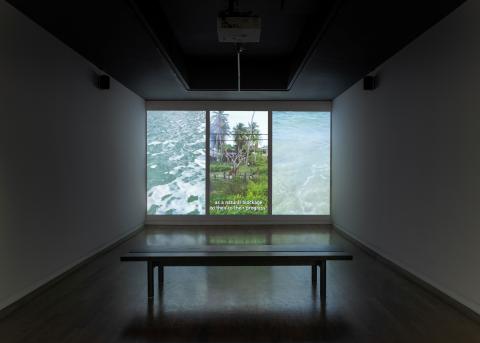
Here, the river is understood as a contested ecological space shaped by colonial infrastructures and environmental injustice. Shah analyzes how communities are displaced from the river so that its waters can be used to cool generators, only for these same communities to be later blamed for polluting the very waterways degraded by colonial development. Thus Always About Land exposes how colonial powers physically transform rivers and landscapes as well as the narratives through which environmental harm is understood.
By rejecting the colonial “view from above,” Shah situates the audience as part of the Guyanese landscape. This decision disrupts extractive ways of seeing Caribbean landscapes as properties, plantations, and resources that can be transformed for capital gain. Here, Shah foregrounds environmental sovereignty as the ability for Caribbean communities to define their own relationships to land beyond colonial logics of extraction. The Demerara River, therefore, becomes an archive of colonial history remembered and rewritten by those living with its ongoing environmental consequences.
Extracting: Colonial Infrastructures and Resource Economies
I focus on the works of Charles Campbell and Braxton Garneau to highlight how the exhibition traces extraction from plantation economy to contemporary resource capitalism. Campbell’s Bagasse “references the proto-capitalist economy of the sugar plantation and acts as a metaphor for economic systems that view society and human relationships as by-products” (fig. 3).6 The title refers to the fibrous residue left after sugarcane is crushed, serving as a physical reminder of the sugar industry that transformed Caribbean environments for profit.
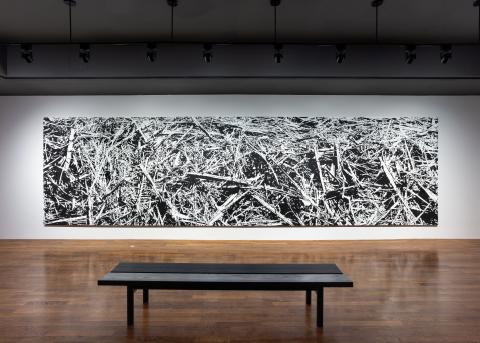
By centering bagasse, Campbell foregrounds what plantation economies deemed low-value or disposable: plant life, physical labor, and the agrarian knowledge of enslaved peoples and their descendants.7 In her monograph, Dark Laboratory: On Columbus, the Caribbean, and the Origins of the Climate Crisis, Goffe observes how plantation economies, monocrop agriculture, and mineral extraction reordered Caribbean landscapes, making environmental transformation central to the history of racial capitalism.8 Read through Goffe’s framework, bagasse reveals how exploitation of land and labor on the plantation produced residues that persist beyond the plantation itself. Bagasse visualizes these residues as evidence of the plantation system’s ecological afterlives and as a site of resistance, alluding to the “burning of cane fields during the uprisings and in present-day labour disputes.”9
Garneau’s Pay Dirt exposes how extraction persists in the contemporary Caribbean through resource capitalism (fig. 4). If Campbell highlights the residues of sugar production, Garneau foregrounds the ongoing extraction of mining, excavation, and environmental depletion. Pay Dirt brings together Albertan tailing ponds and Trinidad’s Pitch Lake.10 According to the wall text, “Alberta and Trinidad both have economies premised in oil production and are linked by the stories of Caribbean families.” The installation reflects the artist’s own family history since Garneau’s grandfather moved from Trinidad in the 1970s to work in the Fort McMurray oil fields:
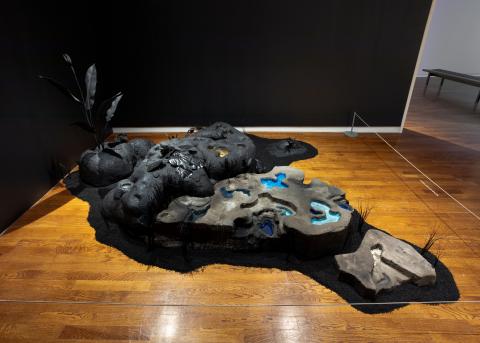
The mixed-media assemblage evokes soil as both substance and commodity. Drawing on mining terminology, the title reduces earth to profitability, echoing the transformation of Caribbean landscapes into economic resources. Garneau’s installation emphasizes material excess, suggesting that extraction is never complete. Instead, extraction produces ongoing ecological and social consequences that cannot be contained within a single historical time frame. Elizabeth M. DeLoughrey contends that Anthropocene narratives often erase the uneven histories of colonialism by presenting the environmental crisis as a universal human condition rather than one rooted in empire and dispossession.11 Pay Dirt refuses this universalization by insisting that extraction in the Caribbean has a specific colonial genealogy rooted in plantation economies and imperial capitalism.
Repairing: Gardens, Care, and Ecological Futures
After exposing the infrastructures related to extraction, Land. Sea. Sugar. Salt. turns toward practices of repair. Rather than a return to wholeness, repair is understood as the cultivation of alternative forms of relation grounded in care, maintenance, and everyday attention to ecology. Farihah Aliyah Shah’s A Garden for Lucille and Giana De Dier’s Untitled (Sunday’s for tending the garden no. 2) meditate on this ecological care.
While plantation agriculture was organized around monoculture and extraction, gardening in the Caribbean has been associated with ornamentation and colonial aesthetics. Thus gardens cannot simply be seen as alternatives to the plantation. The history of provision grounds offers a different model of cultivation: one rooted in subsistence, autonomy, and ecological knowledge. Cultivated by enslaved communities, provision grounds (often cultivated on Sundays) provided food while fostering cultural continuity and forms of autonomy within plantation societies.12 Rather than conflating the garden with the provision ground, I read Shah’s and De Dier’s gardens alongside the history of the provision ground to consider how cultivation becomes a practice of care and relation that extends beyond the extractive logics of the plantation.
Shah’s A Garden for Lucille is an installation composed of soil, lights, waterproof membrane, and tropical plants. Some of these plants are indigenous to Guyana while others were transported to the land, “paralleling the presence of the Indigenous, African, [and] Asian groups who populate Guyana.13 The presence of these plants asserts the validity of ways of knowing that exist outside of Western and Eurocentric worldviews.”14 Unlike static objects on display, Shah’s garden is durational. Figures 5a and 5b showcase this duration in real time: The first photograph was taken on the night of the opening reception (25 February 2026); the second, a few months later (15 July).
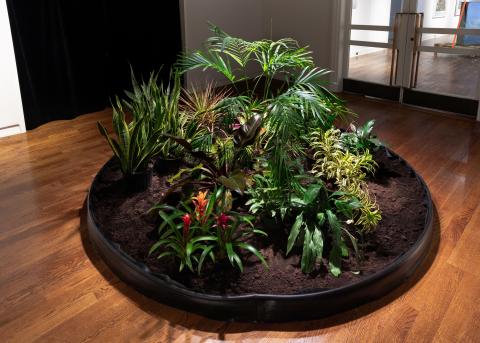
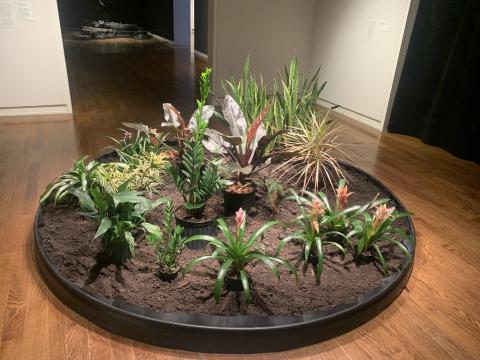
In this way, the installation reimagines the museum’s traditional role as a space for preservation detached from ecological time to a site where growth and decay are visible. In doing so, Shah redefines the archive itself as something living, relational, and unfinished. This emphasis on ecological change connects the installation to Olive Senior’s Gardening in the Tropics (1994), where Senior repeatedly configures plants as travelers whose movements mirror those of enslaved and indentured peoples, rendering botanical life as a record of colonial exchange.15 Like Senior, Shah’s A Garden for Lucille refuses to separate botanical life from colonial history. Every plant included in the installation alludes to both displacement and survival. The work, therefore, imagines environmental care as a form of cultural continuity through gardening.
This attention to everyday ecological practice is extended in De Dier’s .Untitled (Sunday’s for tending the garden no. 2). Through collage, De Dier foregrounds women in black-and-white tending to a garden. Doing so highlights forms of labor that have been historically marginalized within official archives (fig. 6). De Dier’s emphasis on Sunday is especially significant because Sunday was often the only day that enslaved people could cultivate provision grounds, making gardening an act of survival, resistance, and community formation.
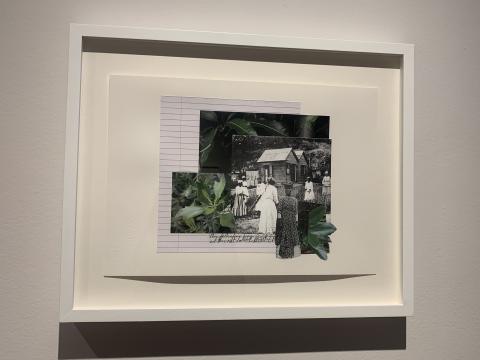
Through collage, De Dier’s refuses to confine these women to historical documentation, making their labor visible. Gardening becomes both an embodied archive and a quiet refusal of plantation logics. If plantations transformed land into commodity, then gardens sustain relationships between people, plants, and place. In addition, De Dier’s collage assembles disparate visual archives into new forms, echoing the Caribbean and diasporic condition itself. If Caribbean identities have long been shaped by displacement and reconstruction, then fragmentation in De Dier’s work signifies the possibility of creating new forms of relation.
Rereading: Caribbean Ecologies as Archive
Land. Sea. Sugar. Salt. demonstrates that visual art is not simply a representation of environmental history but a form of environmental writing. The curatorial arrangement of these works reinforces the exhibition’s broader intervention that no single medium can adequately represent Caribbean environmental histories. This approach reflects Édouard Glissant’s understanding of Caribbean identity as relational.16 Individual artworks maintain their specificity while participating in larger conversations about colonialism, environmental justice, care, and diasporic belonging. Across the exhibition, water, land, and soil accumulate history. Read through this lens, the exhibition reframes what it means to “write” the Caribbean environment. Writing is not confined to language; it becomes an ecological process carried through water, soil, plants, and infrastructure. In this way, writing includes “playing with textural methods beyond and between what the written word offers us.”17
If Walcott writes that Caribbean history is kept in the sea, then Land. Sea. Sugar. Salt. expands this archive beyond the sea alone.18 Rivers, roads, gardens, sugar, and soil all become sites where colonial histories remain materially inscribed. The exhibition ultimately teaches viewers to not simply look at Caribbean landscapes but to recognize that history is actively being written in the ecological worlds that continue to shape Caribbean life.
Acknowledgments
Like the process of curating an exhibition, this essay would not have been possible without the support and generosity of many people. I am extremely grateful to Rachel Mordecai for inviting me to submit this review and to Kelly Martin for her excellent editorial eye. I thank Braxton Garneau, Giana De Dier, and Farihah Aliyah Shah for graciously granting me permission to showcase their work. Finally, my utmost thanks go to Marianne Rellin at the Art Museum at the University of Toronto for providing me with the official exhibition images that accompany this piece.
I dedicate this piece to the people of Namaygoosisagagun First Nation (Collins First Nation) and those in Jamaica who continue to rebuild in the wake of environmental devastation.
Grayson Chong is an artist-scholar whose textile-based pieces explore the intersections of fashion, gender, and race in Jamaica and the Caribbean diaspora. She received her PhD from the University of Massachusetts Amherst in 2025. Her work is deeply inspired and informed by her Jamaican Chinese heritage. From 2024 to 2025, she served as a curatorial assistant for Rendering Revolution / Revolisyon toupatou (Parsons School of Design, New York). Her scholarship and art pieces have been featured in archipelagos, Comparative Media Arts, MaComère, sx salon, and Diasporic Womanist Sociology: Introducing Hope and Solidarity through Non-Western and Global South Communities and Diasporas (Routledge, 2026). In addition to her creating and researching, she is an editorial assistant for sx salon: a small axe literary platform, an associate of the Shakespeare and Dance Project, and the inaugural recipient of the Rendering Revolution Maker-Scholar Fellowship. You can find more about Grayson’s works at https://www.graysonchong.com/.
[1] See Derek Walcott, “The Sea is History,” in Collected Poems, 1948–1984 (Farrar, Straus and Giroux, 1986), 364.
[2] Tao Leigh Goffe, Dark Laboratory: On Columbus, the Caribbean, and the Origins of the Climate Crisis (Doubleday, 2025), xix.
[3] I attended the exhibit twice: the first time during the opening reception on 25 February 2026; the second on 15 July.
[4] To see Kwandibens’s post in its entirety, go to https://www.instagram.com/p/DayNK2nD1bV/. The same day, Brandi Morin (@Songstress28) posted on X: “Collins First Nation is gone. Northern Ontario is choking on smoke from 128 wildfires,” https://x.com/Songstress28/status/2077434838077055237. When reading these apocalyptic realities, I cannot help but wonder if these were the realities Diana McCaulay imagined when she wrote Daylight Come (2020).
[5] Wall text for Always About Land by Farihah Aliyah Shah. Land. Sea. Sugar. Salt.: Terrestrial and Aquatic Contemplations of the Caribbean, 25 February–1 August 2026, Art Museum at the University of Toronto.
[6] Wall text for Bagasse by Charles Campbell. Land. Sea. Sugar. Salt.
[7] See wall text, Bagasse.
[8] See Goffe, Dark Laboratory, xxx–xxxvi, 25–44, 62–67, 71–73.
[9] Wall text, Bagasse.
[10] Alberta’s tailing ponds are the reservoirs built to store waste slurry. Pitch Lake in Trinidad is a naturally occurring bitumen deposit.
[11] See Elizabeth M. DeLoughrey, Allegories of the Anthropocene (Duke University Press, 2019), 1–7.
[12] For scholarship on provision grounds, see works by Ira Berlin, Elizabeth M. DeLoughrey, Lucille Mathurin Mair, Sidney Mintz, John H. Parry, and Sylvia Wynter.
[13] The following plants are included in A Garden for Lucille: Bromeliaceae / Bromeliad; Calathea / Prayer Plant “Pinstripe”; Dracaena marginata / Red Dragon Tree; Dracaena reflexa / Song-of-India; Philodendron erubescens / Philodendron “Imperial Red”; Ravenea rivularis / Majesty Palm; Sansevieria / Striped Snake Plant; Spathiphyllum / Peace Lily (assorted); Stromanthe / Prayer Plant “Triostar”; Yucca gigantea / Giant Yucca Cane; and Zamioculcas / ZZ Plant.
[14] Wall text for A Garden for Lucille by Farihah Aliyah Shah. Land. Sea. Sugar. Salt. A Garden for Lucille connects to another work by Shah titled They Forgot We Were Seeds (2025), which is a response to the Government of Canada’s Global Affairs website.
[15] In Olive Senior’s poetry collection Gardening in the Tropics (McClelland and Stewart, 1994), see “Meditation on Yellow” (11–18), “Plants” (61–62), “Pineapple” (64–65), and “The Tree of Life” (91–92).
[16] See Édouard Glissant, Poetics of Relation, trans. Betsy Wing (University of Michigan Press, 1997), 8.
[17] I take this quote from an Instagram story posted by Larissa Kennedy (@larissa_kennedy_) reflecting on a conversation between Tao Leigh Goffe and Emma Dabiri at Brixton Library, London, on 6 July 2026, for the Dark Laboratory paperback tour. The conversation between Goffe and Dabiri was moderated by environmental journalist, Damien Gayle. Using old photographs as “portals,” Goffe, Dabiri, and Gayle examine family histories as climate histories. See Tao Leigh Goffe (@taoleighgoffe), Instagram post, 16 June 2026. Among the topics discussed were “the power of soundscapes, what we might learn from speculative journeys into the world of human and non-human ancestors, and feel[ing] all the more excited to keep playing with textural methods beyond and between what the written word offers us” (Instagram story by Larissa Kennedy).
[18] See Walcott, “The Sea is History,” 364.